



If Ghana secures its 17th IMF programme in 56 years, it will almost certainly return for another in roughly six years, if the past is any indication. The most recent programmes were in 2003, 2009, and 2015, and, like those before them, they failed to transform the post-colonial economy into a dynamic and resilient one that is able to withstand any shocks, including pandemics, external wars, or a rising dollar.
The reason is simple. Fund programmes are typically short-termand based on analyticaltools and policy prescriptions that are ill-suited, often counter-productive, for a post-colonial economy like Ghana’s, which was structured to serve external interests, not improve the living conditions of its people. The Fund’s debt sustainability analysis, for example, focuses almost entirely on how to service current and future debts (including debt owed to the Fund) and ignores the more fundamental question of how some of the debt came to be in the first place.
When I served on the transition team on the economy in 2001, I coined the term “dirty debt” after reviewing documents on Ghana’s debts dating back decades. Dirty debts arise mainly from factors like inflated contracts and dubious external loans from shadowy commercial interests, or donors out to promote exports from their home countries through “soft” loans. Because their actual contribution to economic growth is doubtful, even harmful, dirty debts can only be repaid by diverting resources from critical sectors such as education, health, and infrastructure. In one notorious case, a project was inflated by US$100 million. A retrospective debt analysis, instead of the prospective one favoured by the Fund, would identify the beneficiaries of such dirty debts, retrieve their ill-gotten wealth (with interest), prosecute them, and take measures to deter recurrence as part of an IMF programme. (I estimate that 20-30% of Ghana’s public debt is dirty debt that can only be repaid through resource diversion).
Most of the Fund’s performance indicators, especially those based on GDP, are also unfit for a post-colonial economy with weak institutions like Ghana’s. The 2015 programme, for instance, was based on the belief that government’s wages and salaries were too high at 7.1% of GDP. The correct figure turned out to be 5.8% after the GDP was rebased in 2018. All other indicators – debt, budget deficit, tax revenue, capital expenditure, and exports – based on GDP, therefore, turned out to be wrong, although they formed the basis for the programme. This may partly explain why Ghana is back at the Fund only two years after completing that programme (with waivers). The ongoing negotiations is heavy with GDP ratios.
The 40-Year Development Plan has the answers
The latest IMF programme, therefore, should be treated as a stop-gap measure, at best, and placed in a Wider Crisis Response Framework (WCRF) based on the 40-Year Development Plan (2018-2057), which has the specific objective of transforming Ghana’s economy and sparing the country the ritualised embarrassment of running to the Fund every time it encounters headwinds in its development. The first of the five strategic goals of the Plan was to transform the economy by building an “Industrialised, Inclusive and Resilient Economy”. What follows largely draws from it.
Creating the conditions for transformation
Economic transformation requires not only a long-term vision but also a sound and predictable policy environment with low inflation, a stable exchange rate, and responsible fiscal policy that strikes the right balance between revenue and expenditure. In such an environment, consumer inflation and the exchange rate, for instance, are two sides of the same coin. If inflation rises from 10.0% to 12.0%, for example, the cedi will have to depreciate by 2.0% to keep Ghana’s exports competitive. If the depreciation overshoots, because of external factors or what economists call “animal spirits” (irrational speculation in currency markets due to growing uncertainty or spooky pronouncements by government officials or their misinformed proxies), this would lead to imported inflation, and the cycle will continue.
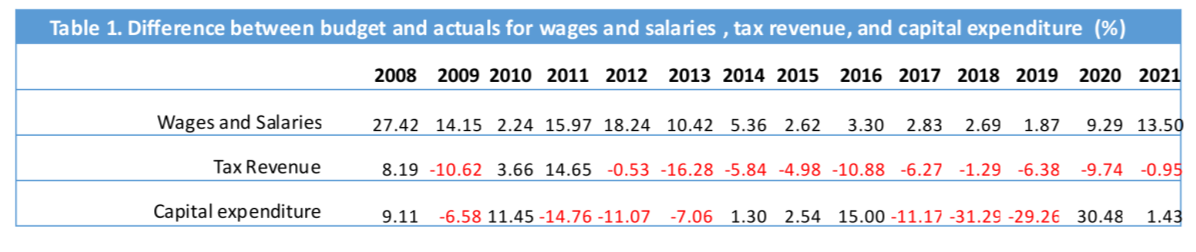
One way to break the cycle is to curb excessive and wasteful public spending, butfor decades successive governments have failed to do that. Table 1 is a snapshot of this “curse” of reckless spending from 2008 to 2021. Wages and salaries overshot their budgetary allocations in each of the 14 years, even though government met its revenue targets in only three of those years. Equally disturbing are the shortfalls in capital expenditure, a driver of economic growth, which generally followed the electoral cycle, with spending spikes in election years and a steady reduction afterwards.
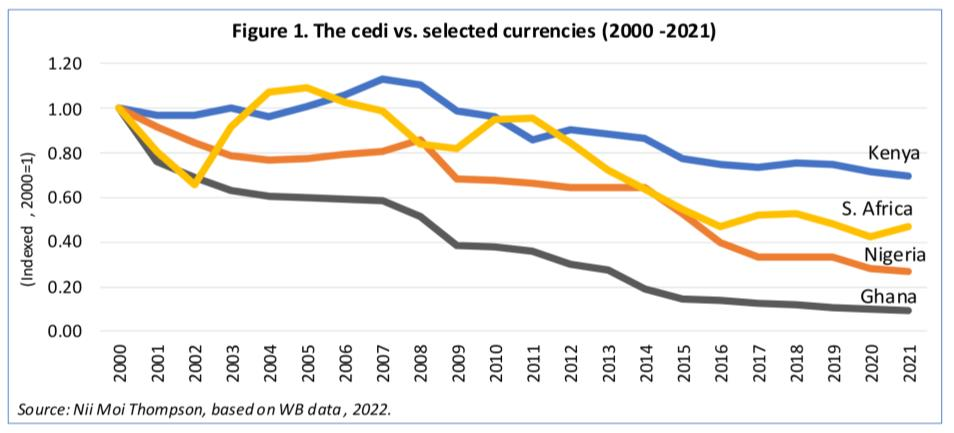
The cedi also suffers from inherent or structural weaknesses that will take longer to address, but whose policy responses must be formulated now. Figure 1showsthe inherent weaknesses of the cedicompared to other currencies, and on its own merit. Between 2000 and 2021, the cedi, the Nigerian naira, the Kenyan shilling, and the South African rand depreciated, but the cedi depreciated the most – by an average of 10.2% per year, compared to 5.7% for the naira, 2.6% for the rand, and 1.6% for the shilling.
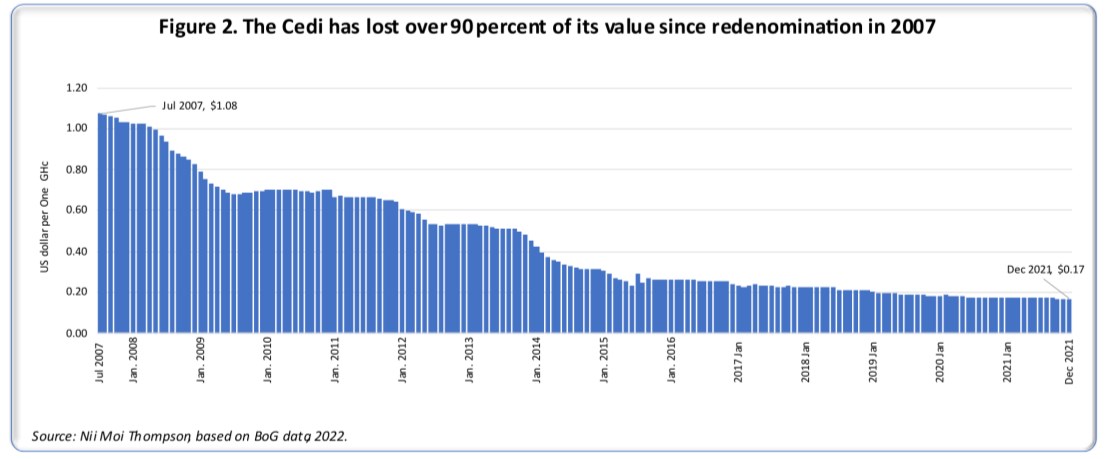
On its own, in 2007, one cedi bought $1.08 after redenomination. By December 2021, the cedi could buy only $0.17(Figure 2), a cumulative depreciation of 84.3%, which extended to about 94.4% by mid-October 2022. Between January and October 2022, it lost about 67.1% of its value against the dollar, compared to 8.0% for the Kenyan shilling. Both countries operate in the same global environment.
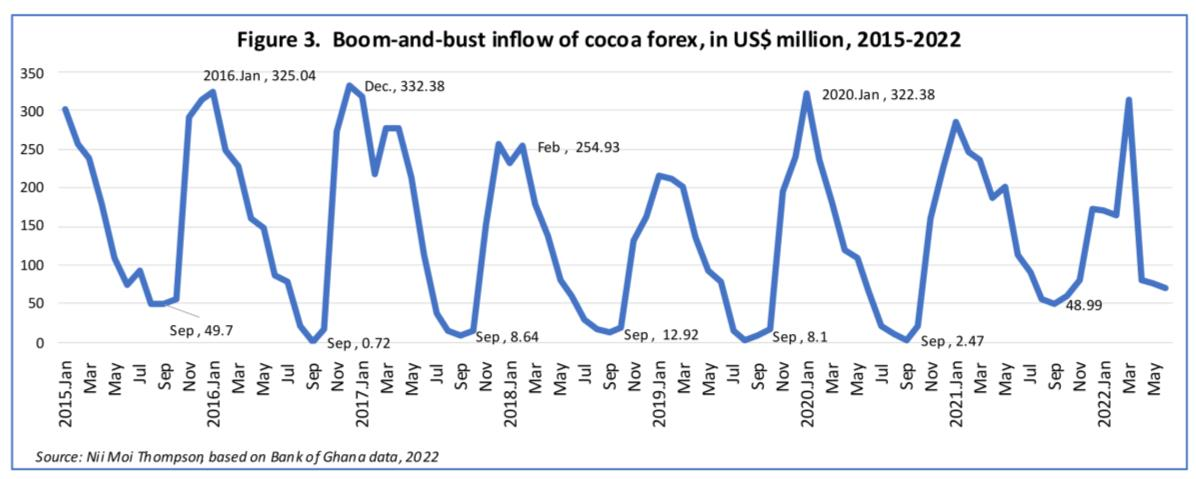
What accounts for the inherent weakness of the cedi? The culprits are many, but one stands out: low diversification of exports and a disproportionate dependence on cocoa inflows, as most of the proceeds from gold and crude oil (two of the three largest exports) are kept offshore. But cocoa is a seasonal crop, and so are its forex inflows, resulting in the boom-and-bust inflows shown in Figure 3, from 2015 to the first half of 2022. (It’s been like that since Tetteh Quarahie). Inflows surge every October/November, as the cocoa season opens, and begin to decline between December and February until September the following year. These logoligi inflows contrast sharply with the steady rise in the demand for dollars during the year. Government has to borrow to close the gap during the period of forex decline as foreign firms and investors repatriate profits and businesses import. The refusal of foreign lenders to give Ghana any more loans due to unsustainable debt is partly responsible for the current crisis.
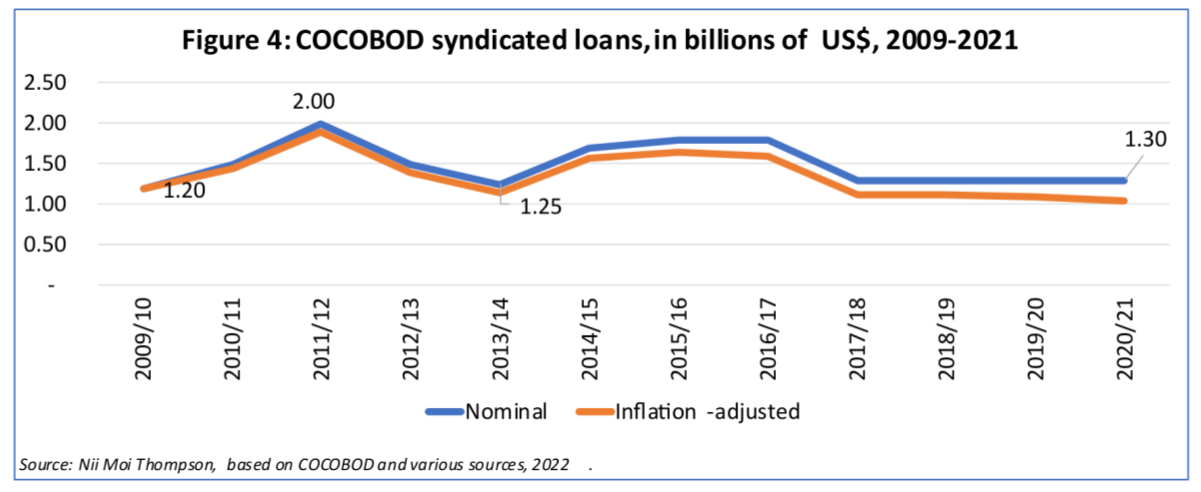
The instability of cocoa inflows is aggravated by an unhealthy dependence on COCOBOD’s annual syndicated dollar loans that are used to buy cocoa beans from October onwards. The highest such loan since the 2009/2010 cocoa season was US$2.0 billion in 2011/2012. Since then, the loan amounts have generally declined (along with cocoa output), to US$1.3 billion in 2020/2021 (Figure 4) and further to US$1.13 in 2022/2023, even as Ghana’s population rose from 24 million in 2010 to nearly 32 million in 2022 and its imports needs to be increased accordingly. Banning certain imports will not save the cedi. Aggressive exports diversification will. (Significantly, as many as 28 foreign financial firms, plus Ghana International Bank in London, combined to raise the US$1.3 billion in 2020).
Industrialisation and inclusive growth
Determinants, policies and strategies for industrialisation and inclusive growth are outlined in the 40-Year Plan. They include nine “structural enablers of growth”, three “cyclical enablers of growth”, and 13 “catalytic initiatives for industrialisation and growth”. The cyclical enablers, for instance, include a proposed cedi depreciation range of 0-5% per year, with the upper limit “reserved” for unexpected shocks, and actual depreciation averaging 2.5% per year based on the policies of the Plan. Electricity being the life blood of industrialisation, the Plan proposed an increase in electricity consumption from 348 kWh per capita in 2015 to 850 kWh per capita by 2021 and 1,433 kWh per capita by 2025. As of 2019, consumption had risen to only 461 kWh per capita. Besides other proposals, such as an Export Advisory Council made up of local and foreign Ghanaian business leaders, the catalytic initiatives include three that have moved to the top of development discourse since Covid: (1) A Productivity development strategy; (2) a Future of Work Strategy; and (3) a Strategy for Transforming the Informal Sector.
The informal sector: transformation, not taxation
The myth that the informal sector sits on massive wealth that government only needs to find creative ways to tax to end its fiscal woes has led to many misguided policies, such as the e-levy, which hamper formalisation and subvert government’s revenue mobilisation efforts. The sector makes up 90.0% of all enterprises and accounts for about 70.0% of employment but contributes only 26.0% of GDP (or, roughly, national income). This suggests low productivity and low incomes, especially for the 67.0% of the labour force involved in survivalist activities like petty trading. What the sector needs is not taxation but transformation, to raise productivity, household incomes, and living standards, whilst accelerating its formalisation and the growth of its tax base for inclusive development. The ILO’s Recommendation 204 would be a great start.
Jobs, jobs, jobs, and more jobs!
Ideally, employment and decent work (as defined by the International Labour Organization) should be the top-most objective of Ghana’s development agenda. The 40-year plan recognised this and projected an annual average of 375,000 jobs, mainly in the private sector, compared to the 320,000 people who enter the labour force annually, for a total of 15 million jobs over the Plan period. According GSS, there were 1.5 million unemployed Ghanaians in 2021, up from 1.2 million in 2016. Of those working, over70%arein vulnerable employment, otherwise known as the working poor. Populist and impractical programmes such as those for “youth entrepreneurship” have failed because not every unemployed youth is an entrepreneur waiting to be made. Most youth in fact require wage employment as their first entry into the labour market, and studies have shown that about 80% of new jobs are created by existing businesses. Besides, countries with higher levels of wage employment tend to have lower levels of poverty with high degrees of economic formalisation.
Creating 15 million jobs will be based on a three-dimensional integrated strategy of (1) Labour demand (economicgrowth), (2)Laboursupply (skills development), and (3)Labour markets (laws and policies). The strategy in turn will be nested in a new framework for Local Economic Development (LED) based on business development, infrastructure development, and social development as part of an aggressive push to accelerate decentralisation. The Business Climate Survey pioneered by GIZ in some districts in 2009/2010 would be a useful complement.
However, the effective implementation of the strategy will require extensive institutional reforms, especially of the sector ministry, which has not had a single labour economist in decades and has been marginalised in the ministerial pecking order for just as long. The labour market information (LMIS), only partially developed after more than 15 years, must be finalised to provide quarterly labour market statistics on employment, wage growth, and other indicators in line with global best practice. Alternative indicators, such as the employment rate, which measures the ability of the economy to absorb labour, should replace or supplement popular but misleading indicators like the unemployment rate, which is unsuitable for developing countries and can undermine employment policy by providing conflicting information about the labour market. To accelerate economic growth and labour demand, government should amend the Bank of Ghana Act to make economic growth and employment the primary objectives of monetary policy, followed by price stability, with the establishment of a labour economics department to guide policy. The current approach to monetary policy is anti-growth and anti-jobs.
De–dollarise the economy
A country that gives its officials US dollarcar loans in the midst of a pandemic to import luxuryvehicles should be the least surprised when its currency later collapses because of lack of dollars. Indeed, during thecrisis,thepublicwas treated to periodic reports ofpublicofficials seeking“medicalreviews” abroad, despite the presence of the Bank Hospital, built by the Bank of Ghana to provide world-class health services and thus help relieve the cedi of the constant pressure of dollar demand from those seeking medical treatment abroad. Everything from hotels to business and residential accommodation to port
charges is priced in dollars, while politicians make campaign promises in dollars without regard for their effect on the cedi. Even the Black Stars are paid in dollars (while the cocoa farmers who bring in the dollars are paid in a depreciating cedi). Government must launch an ambitious agenda for de-dollarisation as part of a broader agenda for transformation and resilience.
Embrace spatial planning and infrastructure development
The 40-Year Plan contains a 20-year spatial development framework to address such things as open gutters, slums, informal settlements, and to promote proper management of the built environment, broadly. The Plan also contains a 30-Year Infrastructure Plan that, among other things, proposes light rail systems in Accra, Kumasi, Tamale, and Secondi-Takoradi as part of the modernisation of public transportation in Ghana. The tagline for the framework is, “Space, Efficiency, Growth”. Both documents are crucial to a growth and transformation agenda and must be implemented.
Confront corruption
No country has smashed the development barrier without first smashing the corruption barrier, which diverts resources for development into private pockets and undermines development. The doubling of the price of a school desk through corruption, for example, means only half the number needed can be bought. The same would apply to stationery, hospital beds, and other forms of government procurement for development. In short, corruption undermines development, and any serious plan for development and transformation must have explicit targets for combating corruption, such as the number of criminal prosecutions in a year and the amounts of money retrieved for the public fiscus.
Finally, face economic reality
In his 2020 budget to Parliament in November 2019, the minister of finance announced declining economic growth rates from 7.0% in 2019 to 6.8% in 2020 all the way to 4.6% in 2022, before rising slightly to 6.5% in 2023. These forecasts followed negative growth in key sectors of the economy, such as construction and water and sanitation sectors (-4.4% each), and the near collapse of the financial sector, which posted successive negative growth for 24 months (between 2017 and 2019). Clearly, the economy was in a state of distress long before Covid and later Ukraine. Acknowledging this fact and identifying the policy flaws that dealt such body blows to the economy in three short years is critical to understanding the policy prescriptions of the 40-Year Plan and implementing them for the successful transformation of Ghana’s economy.
Highlights and High-Level Targets of the 40-Year Development Plan