


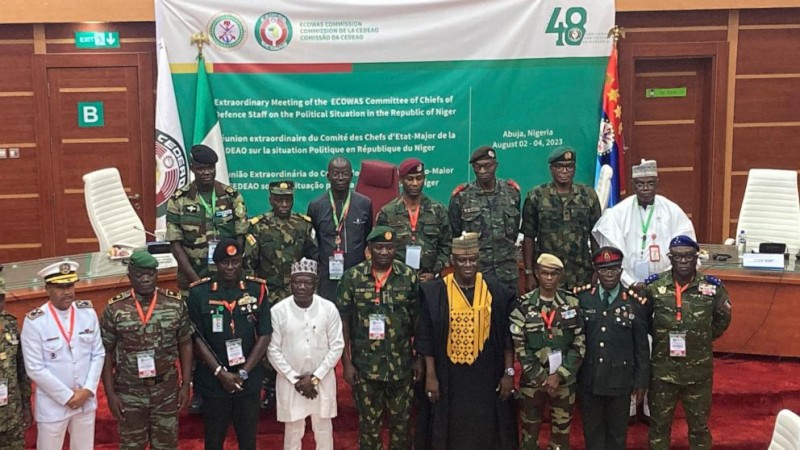
High-ranking army officials from across West Africa gathered for a second consecutive day of deliberations in the capital city of Accra on Friday, converging reports indicate.
The aim of their discussions has been to chart out the intricacies of a potential military intervention, should diplomatic avenues falter in reversing the aftermath of the recent military coup.
Having unseated Niger’s President Mohamed Bazoum on July 26, military officers at the helm have shown a brazen defiance against international appeals from entities like the United Nations and the Economic Community of West African States (ECOWAS) to reinstate the ousted leader. Such obstinacy has compelled regional powers to order the prompt assembly of a standby force, ready to be deployed if circumstances dictate.
Across the course of this intensive two-day gathering, set to culminate in a ceremonial closure around 16:00 GMT, defense leaders have been engrossed in exhaustive talks about the logistics and multifaceted dimensions of a prospective military involvement. The official itinerary confirms the meticulous consideration being given to this grave matter.
Clarifying the regional bloc’s stance on resorting to force, ECOWAS Commissioner for Political Affairs, Peace, and Security, Abdel-Fatau Musah, stated at the outset of the regional bloc’s meeting on Thursday, “While the application of force is envisaged as a final recourse, the intrepid armed forces of West Africa are resolutely poised to heed the call of duty should all other avenues prove futile.”
Among other outcomes, this pivotal summit unveiled that a majority of the 15 member states forming the ECOWAS bloc are poised to contribute to the standby force, with the exception of nations currently under military governance – namely, Mali, Burkina Faso, Guinea – and the diminutive Cape Verde.
Folahanmi Aina, Associate Fellow at the Royal United Services Institute, has argued that the repercussions of any escalatory steps could be deeply destabilizing for the Sahel region, an already fragile and poverty-stricken belt of West Africa, grappling with a relentless decade-long insurgent surge. As Aina sees it, the ongoing intensification of turmoil in the Sahel region risks further constricting the already limited progress in the region.
Niger’s significance resonates beyond its West African confines, primarily attributed to its strategic reserves of uranium and oil. Moreover, the country’s pivotal role as a conduit for foreign troops involved in the relentless battle against insurgent factions affiliated with al Qaeda and the Islamic State adds another layer of complexity to this intricate situation.
Analysts are closely following the proceeds of the ongoing discussions as the situation evolves, with many recognizing that the outcome could indelibly shape the course of not just West African politics, but also the broader global security landscape.