




It’s often said that anyone Black and American should make a pilgrimage to Africa.
This statement proved true, as this writer’s first trip to Ghana, West Africa, was rewarding and invigorating. What’s more, it allowed a feeling of freedom from the confines of America’s antagonistic efforts against Black people.
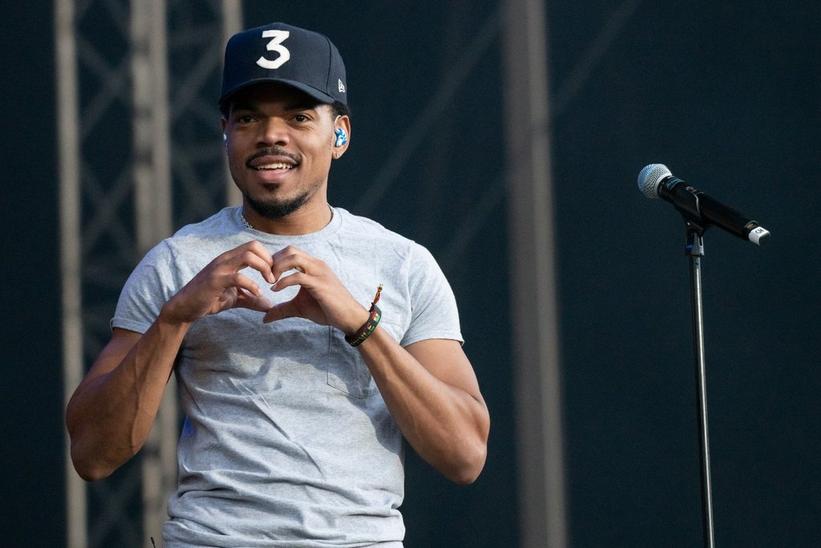
For GRAMMY-winning hip-hop artist and multi-hyphenate Chance the Rapper, a visit with friend and fellow Chicago artist Vic Mensa turned into more than a vacation getaway. Mensa, whose father’s side of the family is Ghanaian, offered Chano an opportunity to experience the Motherland, its rich musical culture, and art scene free from corrupt, consumerized colonialism.
Inspired by the freedom he felt, Chance took four more trips to the Gold Coast, where he met with visual artists like Naila Opiangah, Ghanaian singer-songwriter King Promise, and others and was compelled to create a free concert series styled in the likeness of 1966’s Festival of Algiers.
This event, the Black Star Line Festival, will be held in Accra’s Black Star Square, a longstanding monument to the political freedom that Ghanaians won in 1957.
The weeklong experience takes place on Jan. 6 and will feature events, panel discussions, art installations, and a concert performance starring Chance, Mensa, Erykah Badu, Sarkodie, Jermih, T-Pain, and others.
Speaking with GRAMMY.com ahead of the Black Star Line Festival’s opening, Chance the Rapper delves into his own artistic growth, the importance of building a bridge back to Africa, how hip-hop has saved his life, and why Vallejo, California’s LaRussell happily reminds him of himself.
How would you describe this artistic iteration of Chance the Rapper that we’re witnessing now?
I’m leaning [more] into the collaborative part of myself. Throughout my career, I’ve always valued working with other artists from different backgrounds. From rappers to poets to instrumentalists to dancers, I’ve especially loved working with visual artists. I definitely attribute a lot of that energy due to Coloring Book and Brandon Breaux’s incredible art he created for the album.
People who saw that told me that that’s what pulled them into listening to the album when they had no idea who I was. And now, you see that style of headshot, portrait, and watercolor in other ways through hip-hop after Coloring Book came out, so he [Breaux] really stamped something with that.
So, in this era of my life, I am leaning heavily toward what comes out of the collaboration between myself and the global Black person who comes from different life experiences and loves making stuff.
Lastly, I am making sure to be more intentional with my words, for sure. That can be attributed to a specific person — Cody Chesnutt. We met this year, and I spent about a week in the studio together, where we made some beautiful work for the album.
I’ve been carrying this quote he shared with me regarding intentionality around words, saying, “Every conversation is a construction site. The question is, what are we building with the words we are saying?”
To me, music is a conversation between ourselves and the reality of the world we’re in. It’s full of our opinions and our depictions, but within that, am I building? Am I destroying? Am I adding to something important or insignificant? We, as musicians, don’t always get a chance to realize the answers to those questions.
Mia Lee and yourself had a stellar unveiling at Los Angeles’ MoCa museum, which served as a prelude to your new project. You are part of a group of artists helping to bridge the gap between Black Americans and their African musical heritage. How does that impact you?
There’s so much groundwork that’s already been laid down for us to where this connection feels like history in the making. For example, when I came to Ghana, I didn’t go to Cape Coast or Elmina Castle to gain my understanding.
In my four trips to Ghana, I’ve never gone to the slave castles — and it’s not because I don’t understand how much that place changed the whole world—but I learned amongst the people, finding equal value in learning about Kwame Nkrumah, the revolt in 1957, how Ghana gained their independence, and how interconnected that moment was with the civil rights movement in the United States.
When it comes to Black people, the idea of Marcus Garvey or Mansa Musa is completely absent when it comes to this crossing of information that has impacted Black Americans.
What we’ve done, in terms of our impact on trade and voyaging, is not readily accessible in media. Ghana has a strong history of creating a global Black identity and as a place of refuge for Black people, and I think that we can continue to magnify and improve access to that information because it is important to do so.
It is an otherworldly and rewarding experience to immerse yourself in a cultural hotbed like Ghana. As someone who has always been focused on elevating the youth, will there be other activations associated with the Black Star Line Festival outside of music?
The festival is inspired by the Festival of Algiers in 1966, which had a host of events that culminate with a concert.
There will be talks at the University of East Legon, where Malcolm X once spoke; art showings at the National Museum Ghana, as well as a new exhibition that I put together called Global Black Revolution, which is a mixture of art and artifacts that describe the history of the Algerian revolution, Ghana’s fight for independence in 1957, and the Haitian revolution.
So, many of our proposed differences have been used against us to the point we find ways to separate ourselves amongst ourselves. The more we can create spaces for ourselves to convene, have important discourses, and talk openly amongst ourselves, the more our realities will connect.
2022 marked the 10-year anniversary of your debut mixtape, 10 Day. Did you do anything to commemorate the milestone? And at any point while creating that project, did you have any intention or dream that you would go on to make history in the music industry and at the GRAMMYs?
[Laughs] No, I didn’t know, and I think about the foundation involved in 10 Day. I remember I would get into it with my dad because CDs were still popular at the time, and I was stealing them from Office Depot to put out my music.
Eventually, he would buy me blank CDs to burn, but he would have to spend money to do so. [Laughs] I didn’t have a job, and in retrospect, it wasn’t that much money, but I don’t know. He would buy these CDs and would approach my music-making in a ‘Yo, where’s my money back’-type way.
I would tell him that I had been giving the CDs away for free, which led to a longstanding debate for about three or four years about why I was giving away music for free.
For me, it was always about making sure that I could get my voice out. I used to stand outside of Columbia College, passing out CDs, and trying to have one good conversation with someone about why this project was something to take home and really listen to.
So, when I put out 10 Day that way and Acid Rap, the same way, it was all about wanting as many people to hear me as possible. I don’t want to put up a paywall between myself and others.
When Acid Rap caught on, I remember people wanting me to submit it to get an ISRC code, a barcode, to be eligible for the GRAMMYs. I, a contrarian, and only 20 years old, was like, ‘F<em></em>k that, they got to change for me!’ Surf [laughs] dropped and didn’t get nominated, so I held out one more time for Coloring Book, and [the GRAMMYs] ended up changing the rules six months before the submission process had closed.
I always knew that my career path would look different from others in the game. It was always a goal of mine. I wanted to sound different, release my music in different ways, and collaborate with different kinds of people.
But now, I understand the importance of having independence, and my relationship between that belief and the industry has definitely grown after releasing those two tapes.
LaRussell, a Vallejo MC who has built upon your blueprint, has endeared himself to music fans who love an artist with an entrepreneurial spirit. Have you two crossed paths yet? How do you feel about the impact his movement has made in music?
[At the time of this interview] I hadn’t met him yet, and I planned on going out to Vallejo, but we just haven’t connected yet. I’ve talked to him on the phone. He was actually on the original lineup for the Black Star Line Festival, but we couldn’t make it work. He is interested in doing the next one.
[LaRussell] embodies everything that I wanted to see in an artist. He really stands on being independent in a way that’s both very intentional and incredibly transparent.
He will share the information that he learned about this whole system, which is something I’ve always wanted to see happen. I would be crazy not to support him and encourage him to do amazing and wondrous things.
He’s created an entire ecosystem of fans that even exist outside of his general fanbase. He’s undeniably talented, a good songwriter, and a multi-talented rapper. Without that, nothing works.
You can’t just be a business-minded person or scream “independence,” and not be dope—yet the way he stands on that s<em></em>t and the things he raps about—he reminds me a lot of myself.
2023 marks not only the first year of the Black Star Line Festival but the milestone birthday of hip-hop turning 50. Do you have any plans to celebrate? What does this moment for hip-hop mean to you?
Hip-hop is one of our loudest and strongest tools in the war for our liberation. No matter how many people have tried to commodify it, dilute it, and weaponize it against us — it’s always found its way to remain the truth that it is consistently.
I love hip-hop with all of my heart. Hip-hop, if it manifested into a person in human life, would be hugged by me like it was one of my elders. Thank you, hip-hop; you saved my life.