

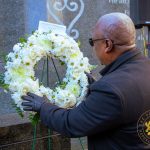


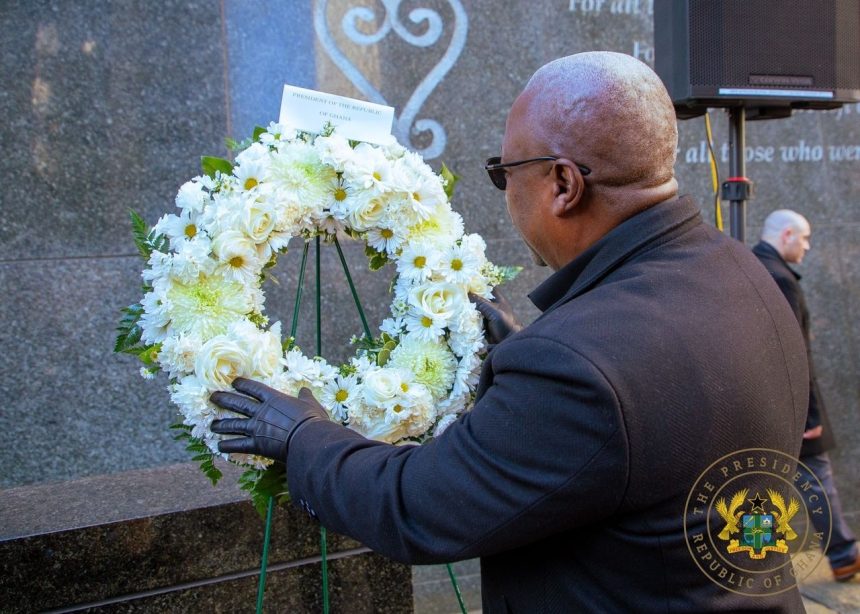
President John Dramani Mahama of Ghana has led a solemn wreath-laying ceremony at the African Burial Ground National Monument in Lower Manhattan, New York, paying tribute to the nearly 20,000 Africans interred at the site — most of whom were enslaved.
It comes amid his push for the formal recognition of the transatlantic trafficking and enslavement of Africans as a crime against humanity.
Speaking at the monument, President Mahama said: “We lay down this wreath to honour the memories of the nearly 20,000 Africans who are buried on these grounds, some of whom were free but most of whom were enslaved.”
The President drew a direct historical line between the memorial site and Ghana, noting that the West African nation is home to more than 30 slave castles and forts — more than any other country on the continent. He said this made it highly probable that many of those buried at the New York site had either passed through or originated from what is now Ghana.
In an address that touched on loss, identity, and the enduring legacy of the transatlantic slave trade, President Mahama extended the scope of remembrance beyond those who perished.
“We lay down this wreath in remembrance of all the victims of slavery and the transatlantic slave trade — the men, women, and children who were taken from their lives and from those who loved them to be enslaved in a foreign land; and also, the people to whom they belonged, whose lives were forever altered,” he said.
The ceremony formed part of a wider programme of engagements in New York centred on remembrance, justice, and advancing the global conversation on reparatory justice.
The transatlantic slave trade, which spanned roughly four centuries from the late 15th to the 19th century, is estimated to have forcibly displaced more than 12 million Africans to the Americas and the Caribbean. Historians consider it one of the largest forced migrations in human history. The vast majority were transported under brutal conditions, with millions perishing at sea during the Middle Passage alone. The trade left a profound and lasting impact on the societies, economies, and cultures of Africa, the Americas, and Europe alike.
The African Burial Ground National Monument, designated a US national monument in 2006, is considered one of the most significant archaeological discoveries of the 20th century. The site, which dates to the 17th and 18th centuries, was rediscovered in 1991 during construction work in Lower Manhattan.
