



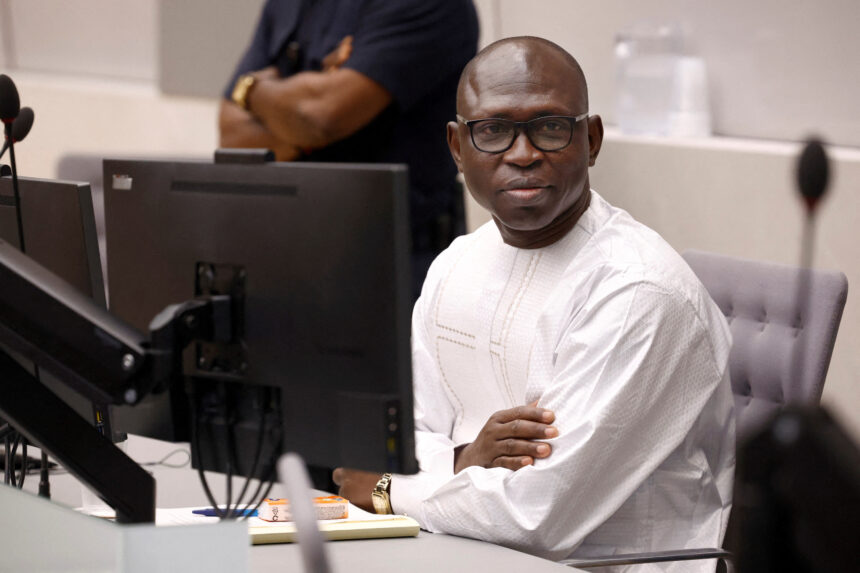
In a surprising turn of events, the International Criminal Court (ICC) prosecutor has chosen to drop charges against Central African militia leader Maxime Jeoffroy Eli Mokom Gawaka.
The decision comes after the prosecutor determined that there was no longer a reasonable prospect of conviction at trial, even if the charges were confirmed.
Some 20 charges, including murder, extermination, deportation, torture, and persecution, were dropped against a former government minister from the Central African Republic.
Maxime Jeoffroy Eli Mokom Gawaka, 44, was initially facing charges of war crimes and crimes against humanity for his alleged involvement in numerous atrocities committed against Muslim civilians in the Central African Republic with his self-proclaimed self-defense militia in 2013 and 2014.
He was accused of coordinating the operations of the anti-Balaka, a mainly Christian group that fought against the predominantly Muslim Seleka rebel group. The fighting left thousands dead and displaced hundreds of thousands in the former French colony.
Karim Khan, the chief prosecutor at the court based in The Hague in the Netherlands, issued a statement saying he was withdrawing all charges against Maxime Jeoffroy Eli Mokom Gawaka because there were “no longer any reasonable prospects of conviction at trial.”
“Having considered the totality of the evidence in the Mokom case and in light of changed circumstances regarding the availability of witnesses, there are no longer any reasonable prospects of conviction at trial even if the charges were confirmed,” the prosecutor’s office said.
Prosecutors had earlier said that Maxime Mokom, a former national coordinator of so-called anti-balaka militias, played a key role in a plan to violently target the Muslim civilian population
These crimes included attacks on civilians, murder, rape, and the recruitment of child soldiers.
The ICC prosecutor’s decision to drop the charges is based on an assessment of the available evidence and the likelihood of securing a conviction. While the initial charges were serious, the prosecutor concluded that the evidence presented did not meet the necessary threshold to guarantee a successful prosecution. In light of this, it was determined that pursuing the case further would not be fruitful.
At a hearing in August, Mokom said he had played no part in any of the violent attacks on Muslim civilians in 2013 and 2014 that prosecutors wanted to charge him with.
He told the court he was a refugee stuck in the neighbouring Democratic Republic of Congo for most of the period referenced in the charges, while the prosecutors said he coordinated the deployment of militias and oversaw attacks.
During a pretrial hearing in August, Mokom’s defense team told judges that prosecutors had already uncovered evidence that could exonerate Mokom, even before his arrest in neighbouring Chad in 2022.
It is important to note that dropping charges against Maxime Jeoffroy Eli Mokom Gawaka does not absolve him of any wrongdoing. Instead, it reflects the current limitations of the evidence and the difficulties in meeting the high standards of proof required in such cases.
Khan said he was aware that survivors and their families would likely be disappointed by the news. “I hope many will understand my legal and ethical responsibilities to be guided by the law and the evidence,” he said in his statement.
The dropped charges against Maxime Jeoffroy Eli Mokom Gawaka underscore the complexities of international criminal proceedings and the ongoing need for comprehensive investigations and compelling evidence to secure successful convictions.
Mokom is the fourth suspect from the long-running conflict in the mineral-rich but impoverished nation to appear before judges at the global court.
CAR has been mired in violence since a coalition of mostly northern and predominantly Muslim rebels known as Seleka, or “Alliance” in the Sango language, seized power in March 2013.
However, militias known as anti-Balaka later fought back, also targeting civilians and sending most of the Muslim residents of the capital, Bangui, fleeing in fear.