







In 1997, the British fantasy author Neil Gaiman received a call out of the blue from then-head of Miramax, Harvey Weinstein. “This animated film, Princess Mononoke,” Gaiman recalls him saying, “it’s the biggest thing in Japan right now. So I thought I’ve got to get the best to do it. I called Quentin Tarantino and said, ‘Quentin, will you do the English language script?’ And he said, you don’t want me, you want Gaiman. So, I’m calling you.” Miramax, a then-subsidiary of Disney, had acquired the rights to distribute Princess Mononoke, the newest film from Japanese animation studio Studio Ghibli, in the United States, and Weinstein wanted to fly Gaiman to Los Angeles to watch a cut of the movie.
“I had zero plans to do it,” Gaiman tells BBC Culture. “But the moment that changed everything for me was the scene where you’re looking at this large pebble. And then a raindrop hits it. And then another raindrop hits it. And then another raindrop hits it. And now it’s raining and the surface is slippery and wet. And I’m like, ‘I have never seen anything like this. This is real filmmaking. This is David Lean-level filmmaking. This is Akira Kurosawa-level filmmaking. This is the real deal.'”
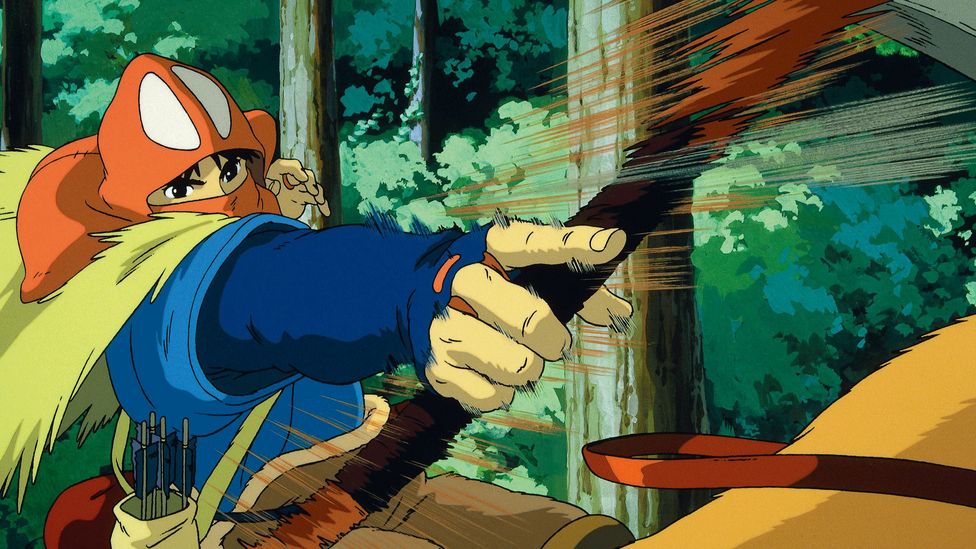
The film’s protagonist is Ashitaka, a young prince struck down by a curse and on a mission to find a remedy (Credit: Alamy)
When Princess Mononoke was first released in Japan on 12 July 1997, 25 years ago this week, it represented something of a departure for master animator and director Hayao Miyazaki. During the late 80s, Miyazaki had built his reputation (along with the success of Studio Ghibli, which he founded with fellow director Isao Takahata) on films like Kiki’s Delivery Service and My Neighbour Totoro; formally ambitious, thematically rich works, but generally affirming in tone and family-friendly in nature. But something changed during the 90s. Firstly, he began to bristle at the popular idea that Studio Ghibli only makes gentle movies about how great nature is. “I begin to hear of Ghibli as ‘sweet’ or ‘healing,'” he grumbles in Princess Mononoke: How the Film Was Conceived, a six-hour documentary about the film’s production, “and I get an urge to destroy it.” Yet even more significant was his growing despair at a world which he had increasingly come to believe was cursed.
“He used to be what he called leftist in sympathy, a believer in people power,” explains Shiro Yoshioka, lecturer in Japanese Studies at Newcastle University. “But for obvious reasons [the collapse of the Soviet Union, and the escalation in ethnic conflicts across Europe], his political beliefs were totally shaken in the early 1990s.”
Japan itself was also going through something of an existential crisis. The country’s bubble period, an economic boom during the late 80s, burst in 1992, stranding Japan in a seemingly endless recession. Three years later, in 1995, the country was hit by the Kobe earthquake, the worst earthquake to hit Japan since 1922. It killed 6,000 people, and destroyed the homes of tens of thousands more. Only two months after that, a terrorist cult by the name of Aum Shinrikyo launched a sarin gas attack on the Tokyo Metro, killing 13 and injuring thousands. Miyazaki, who was sickened by the materialism of the bubble period, was now living in a country traumatised and confused – both by its relationship with nature, and a creeping sense of spiritual emptiness.
“He began to think,” says Yoshioka, “maybe I should not make this entertaining, light-hearted stuff for children. Maybe I should make something substantial.”
A new anger
Set during the 14th Century, the Muromachi period of Japan, Princess Mononoke tells the story of Ashitaka, a young prince cursed by the hatred of a dying boar god, who has been corrupted by an iron ball lodged in his body. “Hear me loathsome humans,” the boar says, “you shall know my agony and my hatred”. To seek a cure for his curse, Ashitaka travels across the land, hoping to find the Shishigami, a deer-like forest spirit with the power to bring life and death.
Along the way, Ashitaka discovers a world out of balance. The ironworks community of Tatara, run by the enigmatic Lady Eboshi, is ravaging the nearby forest for resources, provoking the wrath of ferocious wolf god Moro and her feral human daughter San (the titular Mononoke, which roughly translates to spectre or wraith). Caught in the middle is Ashitaka, who must figure out how to navigate this difficult world with “eyes unclouded”. “I always loved that [phrase],” says Gaiman. “Unclouded by evil. Unclouded by fear, unclouded by hate. You just have to see what’s actually there.”
Compared to Miyazaki’s previous work, it is a dark and angry film, full of strange spectacle and scenes of startling violence. Hands are severed. Heads are cut off. Blood gushes from both human and animal alike. “I believe that violence and aggression are essential parts of us as human beings,” Miyazaki once told journalist Roger Ebert. “The issue that we confront as human beings is how to control that impulse. I know that small children may watch this film, but I intentionally chose not to shield them from the violence that resides in human beings.” Indeed, the cursed boar god, whose anger bursts out of him like a writhing nest of oily worms, was inspired by Miyazaki’s own struggle to control his rage.
Hayao Miyazaki is a self-confessed bundle of contradictions. Read his writings, listen to his interviews, watch him speak, and he paints a portrait of an artist caught between idealism and nihilism, optimism and despair. He is the pacifist with a fascination for war planes; the demanding boss who despises authority, yet, as a director, wields it ruthlessly; the father who believes passionately in the spirit of children but was hardly home to raise his own; the staunch environmentalist who struggles to live an ecologically ethical life. “When I see tuna being hauled in on a line I think ‘wow, humans are terrible’,” he once told Japanese author Tetsuo Yamaori in 2002, in an interview republished in the 2014 Miyazaki essay anthology Turning Point, “but when someone offers me tuna sashimi, I of course eat it and it tastes delicious.”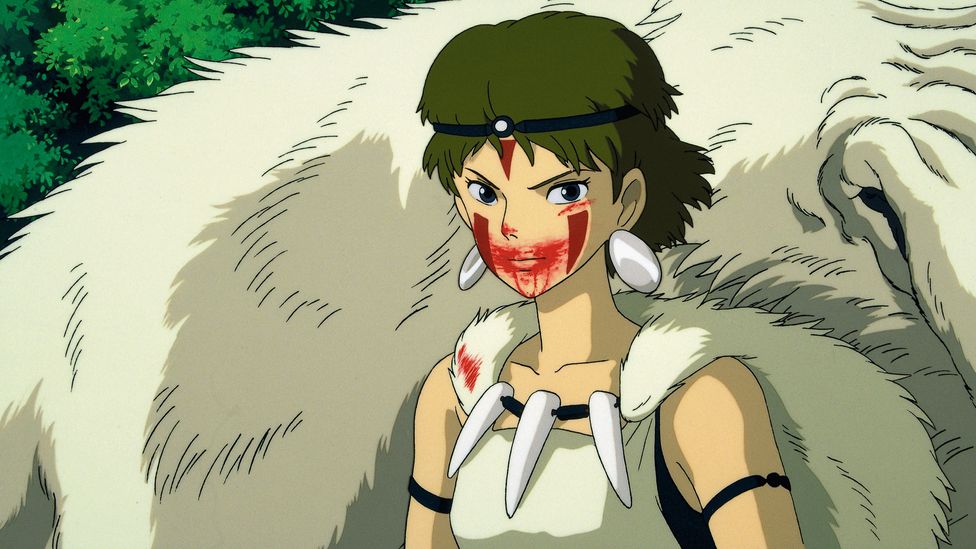
Graphic and bloody violence is a key element of Princess Mononoke, making it far from children’s fare (Credit: Alamy)
This idea of a man at war with himself is obvious to see in the characters and world of Princess Mononoke: a film that, as Miyazaki told a press conference at the Berlin Film Festival in 1998, “was not made to judge good and evil”. Take Lady Eboshi, whose mining colony is manufacturing an arsenal of guns to use against the forest gods. In most animated movies, she would be cast as the greedy, villainous scourge of nature. But Eboshi is also a generous leader, someone who has liberated women (implied to be former sex workers) from feudalistic oppression, who has provided a safe haven for leprosy sufferers and outcasts, and whose industrialisation work is raising the standards of human life.
“It would have been so easy to have a ‘technology is bad versus the good beasts of the forest’ story,” says Susan Napier, professor of the Japanese Program at Tufts University, Massachusetts, and author of Miyazakiworld: A Life in Art. “But the foundry helps these marginalised people live. it gives them jobs, a source of community, pride.” Speaking in 1997 to Cine Furontosha magazine, Miyazaki himself once rationalised Lady Eboshi with “often, those who are destroying nature are in reality people of good character. People who are not evil diligently take actions thinking they are for the best, but the results can lead to terrible problems.”
With Studio Ghibli you have a sense that, contrary to the Judeo-Christian Western point of view, humans are not necessarily the dominant creatures in the world – Susan Napier
Such moral ambiguity is not only extended to the film’s human characters. The wolf god Moro is as tender as she is savage, while the natural world itself is not presented as a purely virtuous force, but one capable of stupidity and horror. Okkoto, leader of the boar clan, stubbornly charges into battle against the superior forces of mankind, foolishly dooming his race. Meanwhile the cold, uncanny visage of the Shishigami, who during the day resembles a great deer, suggests a side of nature that refuses to be anthropomorphised into something comforting, that is instead unsettling and strange – indifferent to whether you live or die.
“With Studio Ghibli,” says Napier, “you have a sense that, contrary to the Judeo-Christian Western point of view, humans are not necessarily the dominant creatures in the world.” It’s an ethos with arguable roots in Japan’s history of ecological disasters, and in Shintoism, the animistic folk religion of Japan, based around the faith that there is a spirit in all things. Writing in 2006, in promotional material for a new short film, Miyazaki states that, “I am much more attracted to the idea of preserving the forests… not for the sake of humans, but because they themselves are alive.” In the words of Yoshioka, “He believes that we should not protect nature just because it’s useful, or try to control it. Instead, we should respect nature as something which has agency of its own.”
This belief is perhaps encapsulated best in a scene in Princess Mononoke described by Napier as “the Sistine Chapel of animation”. It is the sequence in which a group of hunters, led by the opportunistic monk Jigo, catch a glimpse of the Shishigami in the huge, translucent form it takes after sunset. Miyazaki’s films are invariably beautiful: drawn and animated with an obsessive attention to detail, and painted with the kind of clarity and depth that can make you look at the world with new eyes, like falling in love, or coming close to death. The Shishigami however is quite different. It looms over the forest like a walking night sky; inspiring both awe and terror alike. “It is not cuddly and cute,” says Napier. “It looks other and scary. Then it starts to transform and you see these little Kodama creatures [tiny tree spirits, whose faces are fixed with impish smiles] look on in wonder. It is a sublime moment that has nothing to do with human beings.”
Very different receptions
Princess Mononoke was a sensation in Japan. It grossed over 19 billion yen ($160 million) at the box office, far outstripping the country’s previous record holder, Steven Spielberg’s ET, and launched Miyazaki to new heights of fame and influence. The film’s themes of unrest, which Miyazaki himself had doubted would translate into entertainment, had obviously struck a chord with Japanese society. Although its success can equally be attributed to a deft marketing campaign orchestrated by producer Toshio Suzuki, who had also made a deal with the Walt Disney Corporation to distribute Studio Ghibli’s movies worldwide, including a dubbed theatrical release of Princess Mononoke in the US.
The film itself was considered too mature to be released under the Disney banner. Instead, it was passed on to Disney subsidiary Miramax, headed by Harvey Weinstein, the now-jailed producer who had a reputation for taking art films from abroad and cutting them in such a way that appealed to the domestic market (as he saw it, at least). The contract that Studio Ghibli had signed with Disney however came with a strict condition: Princess Mononoke, which had a run time of just over two hours, could not be cut in any way, shape or form. It was a clause that would prove contentious. In his memoir Sharing a House with the Never-Ending Man, about his time working at Studio Ghibli helping to sell the films to the West, film executive Steve Alpert recalls a moment when Suzuki presented Weinstein with a perfect replica of a Japanese samurai sword. He then, in front of a “horrified” conference room of Miramax employees, “shouted in English and in a loud voice, ‘Mononoke Hime, NO CUT!'”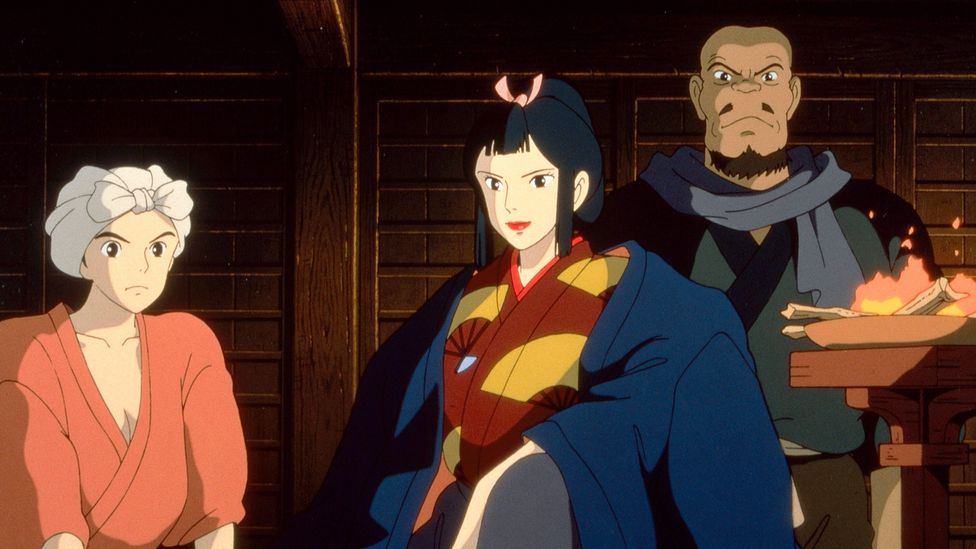
The characterisation of Lady Eboshi (centre), at once a generous leader and a destructive industrialist, is an example of the film’s complexity (Credit: Alamy)
The process of making an English-language version of Princess Mononoke that everyone was happy with was tumultuous. Neil Gaiman, who adapted the Japanese script, recalls being caught in a “peculiar cleft stick” between the demands of Miramax and Studio Ghibli. “You were dealing with one film company in America where everybody was very literal,” says Gaiman. “And one film company in Japan, where being literal was the furthest thing from anybody’s mind.”
Gaiman recalls a particular meeting with Miramax where they seemed to struggle with the concept of an animated film that didn’t hold the audience’s hand. They wanted to know whether Lady Eboshi was a good guy or a bad guy, whether the Shishigami was a good god or a bad god. “Miyazaki built a film in which there are no bad guys,” he says. “There are only consequences. Lady Eboshi is providing shelter for sex workers and people with leprosy, but the results of what she’s doing is throwing everything off balance. You’ve got all of that, and meanwhile you’ve got Miramax going, ‘how will we know Ashitaka is a prince? He doesn’t live in a palace’. And I’m like, ‘Because he’s Prince Ashitaka.'”
There were also other clashes. As detailed in Alpert’s book, Miramax wanted to add their own sound effects to the film, claiming that there were moments so quiet and still that American audience members would think the cinema’s sound had malfunctioned. These included butterflies that made twinkly sounds as they fluttered their wings and, to quote Alpert, “the sound of a cloud passing”. They were vetoed. Gaiman’s script, meanwhile, went through various drafts, but the version that ended up being recorded first – by a US voice cast that included Claire Danes and Billy Bob Thornton – was by someone whose job was to make sure the words aligned with the characters’ mouth movements. “Instead,” says Gaiman, “they took it upon themselves to do a whole script rewrite. And it was that version that was screened for a test audience and booed.” By the time the error was discovered, voice director Jack Fletcher was only able to rerecord just over half of the script.
This has always been a problem when we try to export Japanese animation to the States, because they have this mindset that animation is for children, it has to be dumbed down – Shiro Yoshioka
Princess Mononoke did not perform particularly well in the United States, grossing just $2.3 million domestically. There is a popular idea that this was because a US audience raised on the broad, all-singing, all-dancing animations of Disney were simply not ready for a film like Princess Mononoke. It’s an opinion that Miyazaki arguably shares himself. In 1988, he gave a lecture on Japanese animation that included the line: “There are few barriers to entry into [animated] films – they will invite anyone in – but the barriers to exit must be high and purifying… The barrier to both the entry and exit of Disney films is too low and too wide. To me, they show nothing but contempt for the audience.”
“America still has a very Manichaean binary value system – good, evil, black, white – and it’s baked into the Disney formula,” says Napier. “They usually end with a romance, everyone lives happily ever after, and that’s a fundamental part of the American dream. Whereas Japanese culture is more based on a sense of impermanence. There’s a cycle and a feeling that you have to enjoy what you have. It’s not necessarily a bad world, but it’s a complicated world.”
“This has always been a problem when we try to export Japanese animation to the States,” adds Yoshioka. “Because they have this mindset that animation is for children – possibly born out of its association with Saturday morning cartoons – it has to be dumbed down. In the 1980s, when Miyazaki’s Nausicaä of the Valley of the Wind was exported to the States, it was turned into a very simple story of good vs evil, and Miyazaki was infuriated by that. That’s why he insists now that nothing should be changed when it’s exported to the States.”
Gaiman, however, is not entirely convinced by those arguments. “I don’t think I came away thinking, ‘OK! Huge gulf between America and Japan.’ What I came to the conclusion of was that there is a huge gulf between what Mr Miyazaki is doing and American commercial filmmaking.” Instead, Gaiman thinks that everything that went wrong with Princess Mononoke, “came down to Harvey Weinstein being petty.” He tells a story of how, after the film’s first official screening at the New York Film Festival, Weinstein informed Gaiman that he planned to renege on Disney’s deal not to cut the film.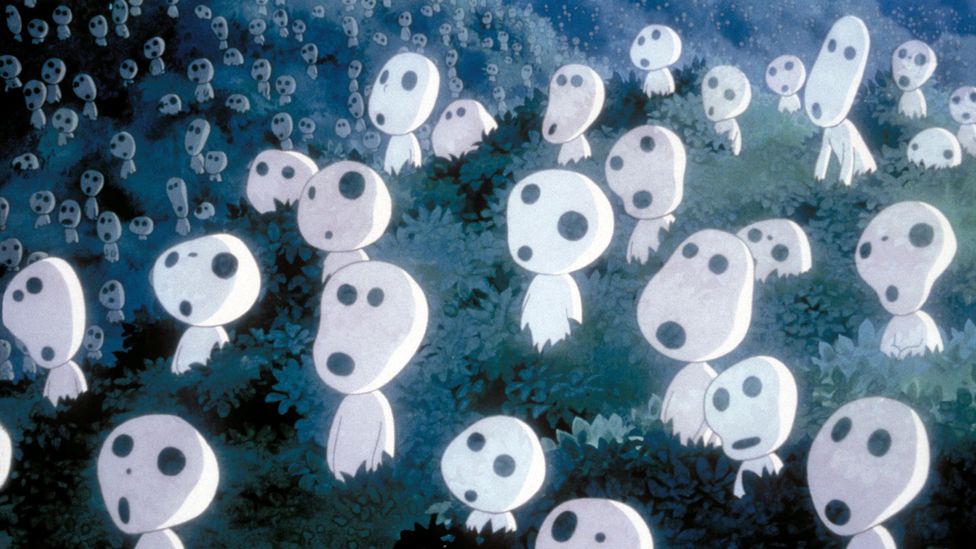
The tiny tree spirits the Kodama feature in the film’s most sublime scene of nature in action (Credit: Alamy)
“He said, ‘we need to cut 40 minutes from it.’. I said, ‘Harvey, you lost that battle before the film came to you. You contractually cannot cut a frame’. He said, “Yeah, still needs to be 90 minutes. I’m going to tell Mr Miyazaki tonight, he’s going to agree.” This was at a celebration dinner at a Cuban restaurant. As Gaiman recalls, Weinstein told Miyazaki and Suzuki the news while they were smoking outside. “Mr Miyazaki, and Mr Suzuki do not return,” says Gaiman. “I ask Harvey what they had said. He replies, ‘well they said no, but they’ll change their mind. Tomorrow the New York Times review is going to come out and say it’s too long. And then they will listen to me’.”
I think if Princess Mononoke had gone out [in the US] to the people who like foreign films, who like Japanese culture, animation fans, horror fans, it actually could have kindled into a phenomenon – Neil Gaiman
The New York Times review, written by Janet Maslin, called Princess Mononoke a “landmark feat of Japanese animation”, with images, such as plants and flowers springing to life beneath the Shishigami’s hooves, that are “simple, meaningful and ravishingly presented”. Nowhere is it mentioned that the film is too long. “And all of a sudden,” says Gaiman, “the next thing I hear is that the fancy launch and giant marketing roll-out for Princess Mononoke that had been planned was not going to happen. It was going to roll out in 10 cities with no particular advertising push behind it. Harvey didn’t even show up for the premiere in Hollywood.
“I don’t see any reason why Princess Mononoke couldn’t have been released and done really well,” continues Gaiman. “But you would have had to send people out there to explain what this was.” He cites the marketing campaign for the film adaptation of his children’s book Coraline, which was projected to make $6 million on its opening weekend, but made $16 million. “And the reason that happened is because we had a PR company who decided to target lots of small little groups, not just parents with kids. I look at Mononoke and think if they’d gone out to the people who like foreign films, who like Japanese culture, animation fans, horror fans, it actually could have kindled into a phenomenon.”
Why it’s more relevant than ever
The relative failure of Princess Mononoke’s US release left Disney lacking confidence in the success of future Studio Ghibli releases. The then-head of Pixar, John Lasseter, disagreed however, and took over the US release of Miyazaki’s next film, 2001’s Spirited Away. Lasseter had been a long-time champion of Miyazaki, and once wrote of how he had inspired him to “slow down the action” in films like A Bug’s Life and Toy Story 2. And yet, despite proving another record-breaking hit in Japan (grossing $304 million), and the English-language version being directed by Beauty and the Beast’s Kirk Wise, it barely broke $10 million in the United States. It did however win the second ever Academy Award for best animated feature (Shrek won the first), although Miyazaki refused to attend the ceremony in protest at the Iraq War.
Princess Mononoke would open a knottier, more socially-conscious chapter in the work of Hayao Miyazaki. 2004’s Howl’s Moving Castle, for example, built on Miyazaki’s Oscar protest with an anti-war story inspired by the invasions of Iraq and Afghanistan; while his most recent film, 2013’s The Wind Rises, was a largely fictitious biography of Jiro Horikoshi, who sees his new aircraft design turned into the Mitsubishi A5M fighter plane, used by Japan during World War Two. The two films, ostensibly a challenge to market for Disney, each grossed around $5 million in the US.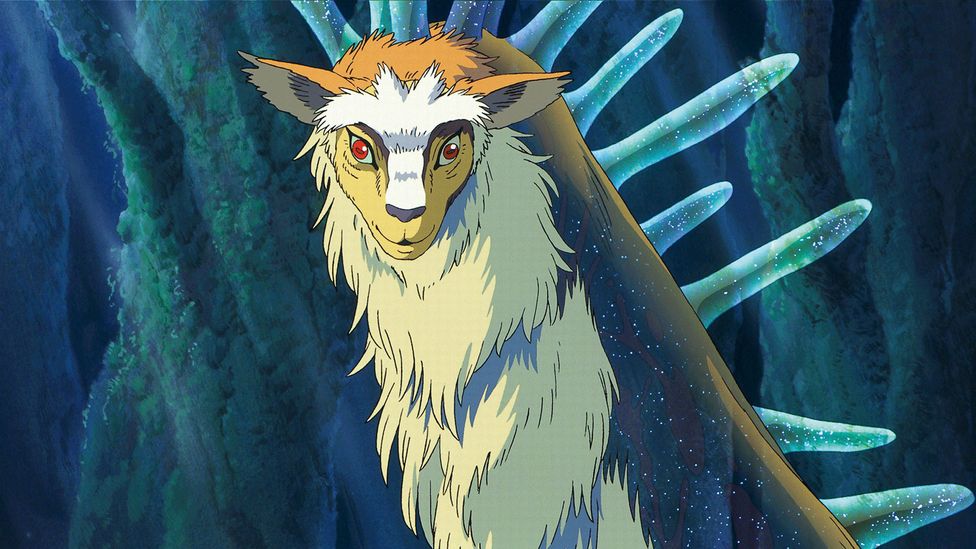
The deer-like Shishigami represents the cycle of life and death that is at the centre of the film’s vision (Credit: Alamy)
“Princess Mononoke is more relevant now than it has ever been,” says Neil Gaiman. “We went through years of people going ‘this climate stuff is going to be a huge problem’. And now suddenly we’re starting to see the results and it’s like, ‘OK, we really are out of whack here and it’s only going to get worse’. And now what do we do? How do we survive? We’re like the people trying to figure it out down in Iron Town. Except we’re not really taking as much care of the sex workers and the people with leprosy.”
But what makes Princess Mononoke such an enduringly profound piece of work is that while Miyazaki is undoubtedly disgusted with the course of humanity, he nonetheless finds his misanthropy giving way to a sincere belief in the resilience of nature and the human spirit. You can see this in the film’s ambiguous ending, when the Shishigami, a living manifestation of the cycle of life and death, threatens to envelope the land in darkness after its head is cut off by Lady Eboshi. But instead, from death comes new life: plants spring again, Ashitaka is healed, a lone Kodama survives – a reminder that nature was here before us and will persevere long after we’re gone. “He’s not dead,” Ashitaka tells San. “He’s here right now, trying to tell us something, that it’s time for both of us to live.”
It is an echo of an enduring theme of Miyazaki’s later work: a rallying call to children, and perhaps to himself, that no matter how bad the world gets, no matter how tempting it is to fall into fatalism or despair, you must keep on going. “Life is suffering,” Ashitaka is told by a man with leprosy his face encased in bandages. “It is hard. The world is cursed, but still you find reasons to keep living.”


