





While mining is the foundational building block of the modern South African economy, it has always had a ‘dark side’.
Historically, the determination of who may and who may not extract South Africa’s rich mineral resources, from diamonds and gold through a long list of key industrial metals, has been ‘political’.
Diamonds were discovered in the country in 1867, when a 15-year-old boy named Erasmus Jacobs found a small transparent rock along the banks of the Orange River, near the farm where he lived with his family in what is now the Free State province.
As the name implies, that region was initially set up in the colonial era for mainly Afrikaans-speaking farmers whose Dutch, German and French settler forebears had fled religious persecution in Europe.
They had again escaped British colonial domination of the Cape and what was then Natal, now KwaZulu-Natal, the home range of the Zulus.
Moved in waves inland
The Boers, as they came to be known, moved in waves inland and away from British colonial rule, sometimes displacing local black communities but also engaging in deals with indigenous communities. Some were allowed to settle in some of these areas.
The Boers were generally as dirt-poor as the indigenous people into whose lands they had moved.
But the discovery of diamonds, followed by the discovery of gold in commercially viable seams in the Witwatersrand, in what is now the greater Johannesburg region, led to the development of support industries and downstream beneficiation.
Thus began the industrialisation of South Africa, then still in part made up of British colonies, with the Dutch overlords having been replaced by the British and ‘free’ Boer states.
Diamond mining
By the 1880s, the mines around Kimberley produced around 95 per cent of the world’s diamonds.
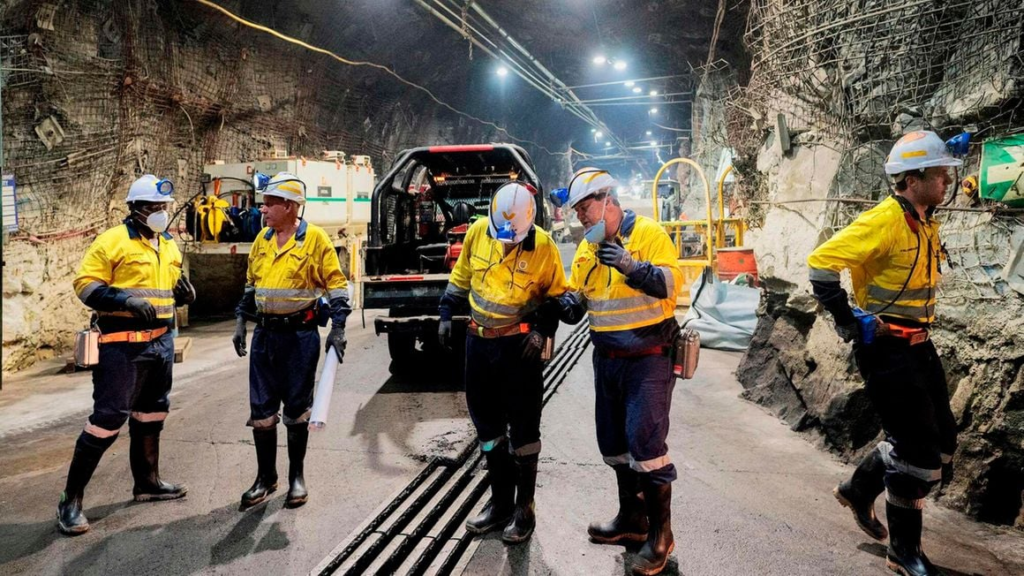
Diamond mining operations had also been concentrated through both legal means and dubious underhand tactics into a handful of corporatised operating entities, most notably De Beers, which is still a major world player in the diamond trade.
Gold had first been found by a hunter in 1834 in the Witwatersrand region of north-central South Africa, but in 1886 alluvial deposits led to the discovery of large and profitable gold seams which quickly, and in turn, led to one of the world’s largest gold rushes that saw South Africa become the largest gold producer in the world for more than a century.
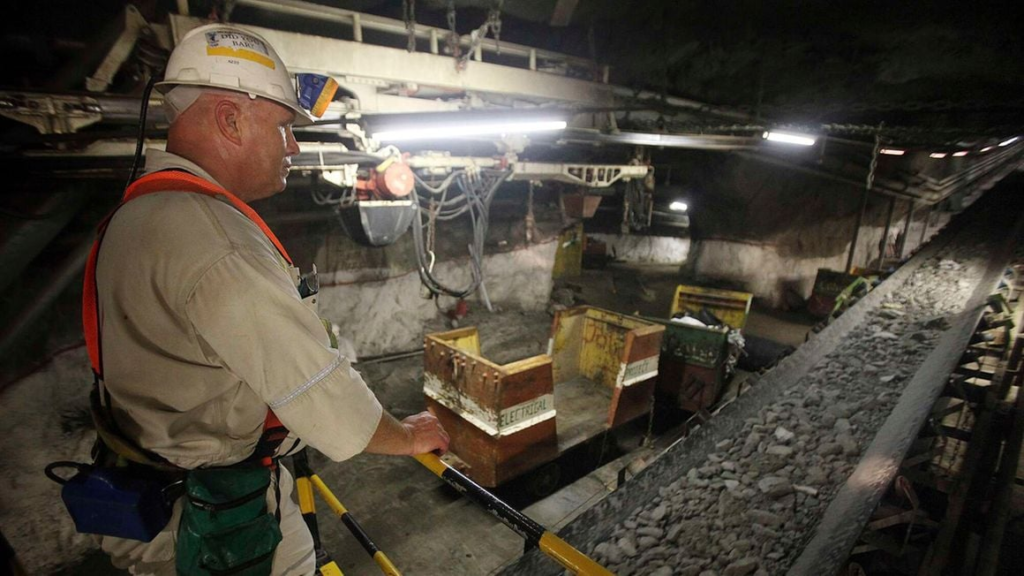
The abundance of gold deposits is without equal anywhere else in the world, with more than 40,000 tonnes of the precious metal having since been mined from rich seams that have been chased up the three kilometres underground.
Despite the depth, cost and danger of such operations, these seams managed to produce an annual average of some 272,128kgs in the 1990-2021 period.
According to the US Geological Survey, South Africa’s gold production was at 110,000kgs for the year ending December 2022, a slight increase on the 2021 production figure of 107,000kgs, which was a marked improvement on the 2020 Covid-hit output of 96,000kgs, a record low.
All-time high
The country’s all-time high was 619,201kgs in 1993, the year before the fall of apartheid.
Output has since steadily declined as gold seams have become ever-deeper, harder and more expensive to get to and extract, and unionisation and political turmoil have cut into mining sector profits.
It was the lure of gold in such large quantities, plus other metals and minerals, that led to two successive ‘Boer wars’ in the 1890s and at the turn of the 20th century.
These brutal conflicts saw the then unparalleled might of the British empire successfully thwarted by bands of Afrikaners, operating in ‘commandos’.
The term ‘commandos’ was adopted by Winston Churchill – who saw active duty initially as a reporter in the Boer conflict – and employed in World War II to designate special forces troops.
Hated British rule
The Boers, as by then these colonial descendants were calling themselves, were determined to rid themselves of the hated British rule from across the ocean.
But the might of what was then the largest and most powerful empire in history won.
The resistance of Boers, undefeated on the battlefield, eventually faltered in the face of Lord Kitchener and his ruthless tactics, which included the first modern concentration camps.
The camps hosted Afrikaner families of Boer fighters and their indigenous farm labourers and sympathisers.
Women and children perished in their thousands in these camps, for which, among some, the British remain despised.
The colonial, self-rule and apartheid regimes reduced mining options until the country’s embedded riches were in the hands of mainly British interests, in a pattern well-known in lands exposed to the brash colonial expansionism of European states in the ‘race for Africa’ that took place through the 19th century.
Unequal competition
From the outset, mining in South Africa has therefore largely been an unequal competition between small alluvial and independent operators and organised commercial and government-backed big business.
The ‘illegal miners’ were locked out to keep the wealth in the hands of a small number of well-connected persons and businesses, with names like Cecil John Rhodes and the Oppenheimers still linked to that process of imposed control and concentration of wealth.
The divide between legal and illegal mining has been maintained ever since, with specific legislation being enacted to prevent mining and ownership of diamonds and gold, in particular, except for government concessions reserved for the well-connected.
The contention around access to South Africa’s mineral wealth led to an uprising in 1922, which began as a mining strike by mainly Afrikaner miners, and eventually was ended only by aerial bombing of parts of the gold reef around Johannesburg, where the striking miners were concentrated, very nearly precipitating a third ‘Boer war’.
Power shortage
In a recent ‘mining indaba’, a conference of mining interests held annually, South Africa’s President Cyril Ramaphosa spelt out the key sector’s major issues, power being by far the leading problem of the day, but with the perennial issue of “illegal mining” close on the power shortage’s heels, as a serious challenge for the sector.
The existence of many gold mining spoils, in large above-ground dumps which litter the landscape around Johannesburg and which still contain significant traces of gold not extracted in prior eras of less sophisticated methods, plus lesser underground residual gold seams left as uneconomical to mine by prior commercial operations, has meant illegal gold mining, in particular, has never gone away entirely.
In recent times, the issue of illegal mining and the so-called ‘invasion of the Zama Zamas’ has received much more attention, as the extent of illegal mining, and the negative impact of organised criminal gangs involved in it, has surfaced as a major socio-economic threat.
‘Zama Zama’
The problem of illegal mining came to a head in late July last year when the long-running ‘Zama Zama’ issue hit the headlines in a whole new and horrifying way after eight young women were gang-raped in Krugersdorp during a video shoot on a supposedly abandoned mining site.
Police Minister Bheki Cele, while launching a clampdown on the illegal miners, who were believed to have been involved, called the incident “the shame of the nation”.
It has been reported that this lucrative illicit ‘industry’ costs an estimated $1.235 billion in lost tax revenue annually and another $824 million in illegal gold production.
According to the EU’s Enact programme, a partnership between the Institute for Security Studies and Interpol, in collaboration with the Global Initiative against Transnational Organized Crime, an estimated 10 per cent of the illegal gold produced in Zama Zama mining is destined for foreign markets.
Violence
This is a relatively small slice of global trade in illegally mined minerals and precious metals, but it has a significant impact not only in terms of losses to the fiscus but in terms of much-increased violence and insecurity for low-income communities living in close proximity to Zama Zama activities.
Reacting to the public outcry that followed the mass rape incident, police swooped on known Zama Zama encampments above ground, arresting more than 130 people, mainly foreigners.
But dozens of others took to their informal diggings, hiding for long periods underground from authorities seeking them, likely using other access points to their illegal and highly dangerous diggings.
Of those arrested, around 30 were charged with being in South Africa illegally, while a group of 14 were subsequently acquitted of rape, sexual assault and robbery, based on their DNA.
The 100-plus arrests in Krugersdorp, as well as in Kagiso west of Johannesburg, only served to slightly reduce an easily replaceable labour force, with those at the top of the illegal mining value chain remaining largely untouched and the illegal mining problem unresolved.
The illegal mining conundrum, and the associated illegal transfers of money, have left South Africa on the edge of being categorised as a “grey-listed” state – lacking or failing to enforce all desired and required international controls and tracking of money flows.
Huge, growing problem
Across the African continent, illegal mining is a huge and growing problem, though it has become particularly prevalent in South Africa, where it has rapidly become both larger in scale and more organised in operations and international sales.
According to Minerals Council member Errol Smart, “illegal mining here is mega-scale corruption and crime”.
According to the Minerals Council, some 20 per cent of the world’s gold comes from artisanal mining, which has “become integral to the economies of many mining countries in the developing world”.
The council also points out that artisanal mining is “plagued with the exploitation of children and women”.
“In Africa, it is estimated that about half of artisanal miners are women and 10 per cent are children,” it said.
Illegal artisanal mining
In South Africa, with Zama Zamas being the underground high-risk takers, and organised gangs the main beneficiaries, illegal artisanal and semi-commercial mining have become almost ubiquitous in mining areas.
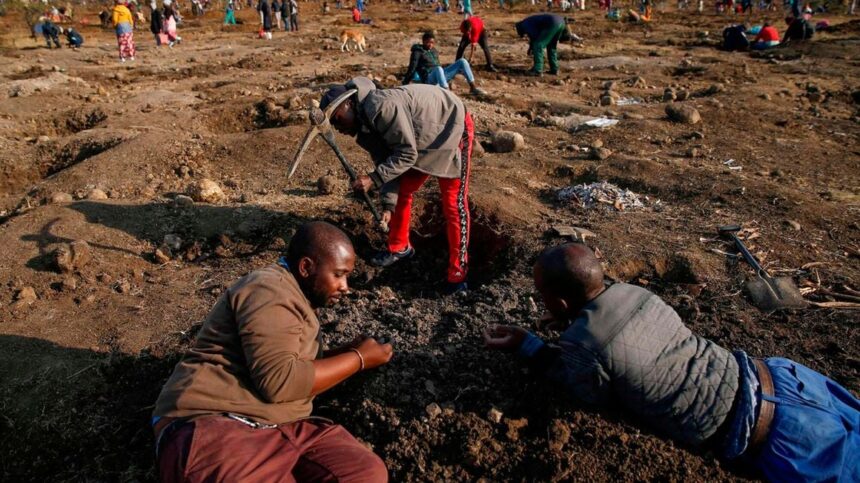
Zama Zama is a Zulu term which means, loosely, “those who try” or “those who keep on trying”, referring to the dangerous and dirty work that many undertake in disused and abandoned formal operations, as the mining sector has shrunk in recent decades from its once-dominant position in the South African economy and as a major employer.
Last year, at least 21 Zama Zamas died when a trench they were cutting collapsed on them, but many more are thought to perish in numerous unreported collapses and cave-ins.
What started out as isolated groups of Zama Zamas working on small operations on alluvial diamond diggings and old, mainly shallow abandoned gold mines on the Witwatersrand in great Johannesburg, has evolved into large-scale mining operations.
The gravity of the situation was evident when an extensive illegal mechanised mining operation on Thungela Resources’ Khwezela Colliery Kromdraai site, near eMalahleni in Mpumalanga province, was recently exposed.
Toxic water spill
The operation came to light due to a serious toxic water spill from the site, for which the formal owners were initially blamed but which the licensed mine operators revealed had been caused by a major illegal mining operation on the ground which Thungela was rehabilitating after it had been mined.
Thungela has been to court multiple times and won interdicts to stop the illegal miners from operating, but the SA Police Service has been unable to enforce these court orders and the mining has continued.
As far back as 2016, organised mining bodies warned that illegal mining was spiralling out of control.
Minerals Council security coordinator Neil Metzer was reported to have said at the time that the issue of illegal mining had been taken up “at the highest level of the country’s security structures”.
In one instance cited by the Minerals Council, a large tailings recovery operation at Kimberley, the site of the largest diamond strike in the world but long since abandoned by major legal operators, had been invaded by more than 1,000 illegal miners and, despite owners having obtained court orders to stop the illegal activity, nothing had been done by authorities.
End Zama Zama threat
President Ramaphosa recently promised that the illegal mining operations would be brought under control and the threat posed by the largely lawless Zama Zamas to the communities ended.
Mining, he said, had been the bedrock of African economies, specifically South Africa’s, “for millennia”, and “continues to play a pivotal role in development and industrialisation across the continent”.
Promising to end illegal mining is one thing, but actually doing so is proving to be another altogether, with industry and security analysts assessing that, without a significant dedicated force tasked solely with this complex and dangerous responsibility, there was little chance that illegal mining in South Africa would be ended any time soon.
Before South Africa’s illegal miners were called Zama Zamas, a Zulu term meaning, in context, “those that try their luck”, they had another collective name, the Marashea.
That self-claimed tag stems from the admiration of the Russians fighting German invaders in the 1940s during World War II, Marashea being a Basotho derivation of “the Russians”.
Zama Zamas in South Africa are mostly foreigners – largely from Lesotho.
Dubious reputation
In their country of origin, and now in South Africa as Zama Zamas, they have earned a dubious reputation for violence, rape, intimidation of local communities and general lawlessness.
Basotho Zama Zama’s are viewed by researchers to be at their core what are called in their homeland “Marashea gang” members, a loose collective which has operated in South Africa’s mines since the 1940s.
According to civil society grouping Right for Education, following the rape of eight young women in Krugersdorp last year, allegedly by Zama Zama miners, illegal mining became a major focus of media and law enforcement agencies, though these groups have existed for decades, even under apartheid.
Some Zama Zamas hail from Mozambique (where they have caused havoc with that country’s ruby mining), Zimbabwe and other regional neighbours.
According to Prof Gary Kynoch, assistant professor of history at Dalhousie University in Halifax, Nova Scotia, Canada, and an expert on crime, policing, and violence in urban South Africa, Basotho nationals have for decades been closely linked to South African mining.
Developing into a violent African criminal society, the Marashea mainly operated in and around South Africa’s gold mining areas.
With thousands of members involved in drug smuggling, extortion and kidnapping, and other illegal activity, the Marashea were more influential in the day-to-day lives of many black South Africans under apartheid than were agents of the state, Prof Kynoch says.
Unchanged over years
These gangs remain active in South Africa, now called Zama Zamas, but essentially unchanged over years.
In his 2005 book, We are Fighting the World: A History of the Marashea Gangs in South Africa, 1947-1999, Prof Kynoch points to the combination of coercive force and administrative weakness that characterised the apartheid state.
As long as crime and violence were contained within ‘black’ townships and did not threaten adjacent ‘white’ areas, township residents were largely left to fend for themselves.
Despite the passing of apartheid nearly 30 years ago, that picture remains largely unchanged.
Violent crime epidemic
The Marasheas’ ability to prosper during the apartheid era, and their involvement in political conflict, led directly to the violent crime epidemic that today plagues South Africa, concludes Prof Kynoch.
Upon arrival to work in South Africa’s mines – their departure an indicator of the impossibility of economically sustaining themselves in Lesotho – the original Marashea faced hostile reactions from communities suspicious of “outsiders” seen to be taking jobs from locals.
Vying for limited resources, the group formed a support network that could also double as a defensive association for vulnerable Basotho migrants.
Their principal objectives were to procure money (primarily through criminal activities), in a market that failed to provide liveable wages and to offer job security to enlisted Basotho.
Prof Kynoch compiled 79 oral testimonies that provide an intimate and in-depth understanding of the individuals that constitute the criminal group.
Human face
Outside of the sensational recounts of Basotho exploits, internecine battles and clashes with the police, these testimonies put a human face on the appalling and inhumane circumstances that many Marashea faced and which, today as the Zama Zamas, they still face.
Their stories explore the extent of human degradation and colonial domination they endured.
Their suffering is captured by one of the veterans of the Marashea, who told Prof Kynoch: “Marashea was a thing of South Africa; there was no need for such a group in Lesotho.”
Writes Prof Kynoch in We are Fighting the World: “The Marasheas’ original purpose was to protect migrant Basotho, so the gangs filled a need that did not exist in Lesotho.”
The situation with the Marashea was not helped by unenlightened, apartheid-era efforts by the white minority authorities to halt their growing grip in mining areas.
The 1963 Alien Act prohibited Basotho nationals from working in industries in S. Africa, besides agriculture and mining.
That legislation only intensified the presence of Basotho nationals in South African mines.
Basotho stronghold
Ever since the bill was passed in 1963, the mining sector has been marked as a stronghold of Basotho nationals in South Africa.
Initially, the Marasheas’ purpose in South Africa was to protect Basotho nationals in mines against other gangs’ attacks.
They also wanted to protect their own from the depredations of mine owners using sundry tactics and the apartheid police to prevent organised labour.
This became an organised criminal undertaking with international links and extensive tentacles in other forms of crime.
Already considered “outsiders”, these ‘Zama Zamas-to-be’ quickly emerged as violent gangs that robbed, raped and terrorised communities living near abandoned mines.
Gang-rape
Last year’s gang-rape of eight young women in Krugersdorp shone the spotlight on the ‘Marashea gangs/Zama Zama’ problem, now fully embedded in mining communities and holding locals to ransom under a reign of terror of which the rest of the country became shockingly aware as a result of the vicious nature of the crimes involved in that incident, and in many others complained of by affected communities.
South African authorities have repeatedly made efforts to at least rein in the Zama Zamas, the Department of Mineral Resources and Energy having published a draft artisanal and small-scale mining policy.
That policy was promptly rejected out of hand by mining experts, who declared it “unrealistic and unworkable” and a “fantasy which would never happen”.
Zama Zama activities persist
The idea was to create valuable open-cast areas where artisanal miners could profitably and legally mine, with previously mined areas excluded to prevent artisanal miners from attracting environmental liabilities.
Despite the policy, there has been no sign of any significant change in Zama Zama activities, and despite police sweeps such as in the wake of the Krugersdorp mass rape incident, they are still at work in their thousands, plying their dangerous and illegal trade at the cost of every South African and, frequently, also of their own lives.
While there is desperation and mass unemployment in South Africa and its neighbouring states, it is a certainty that Zama Zama illegal mining and related criminal conduct will continue unabated.