


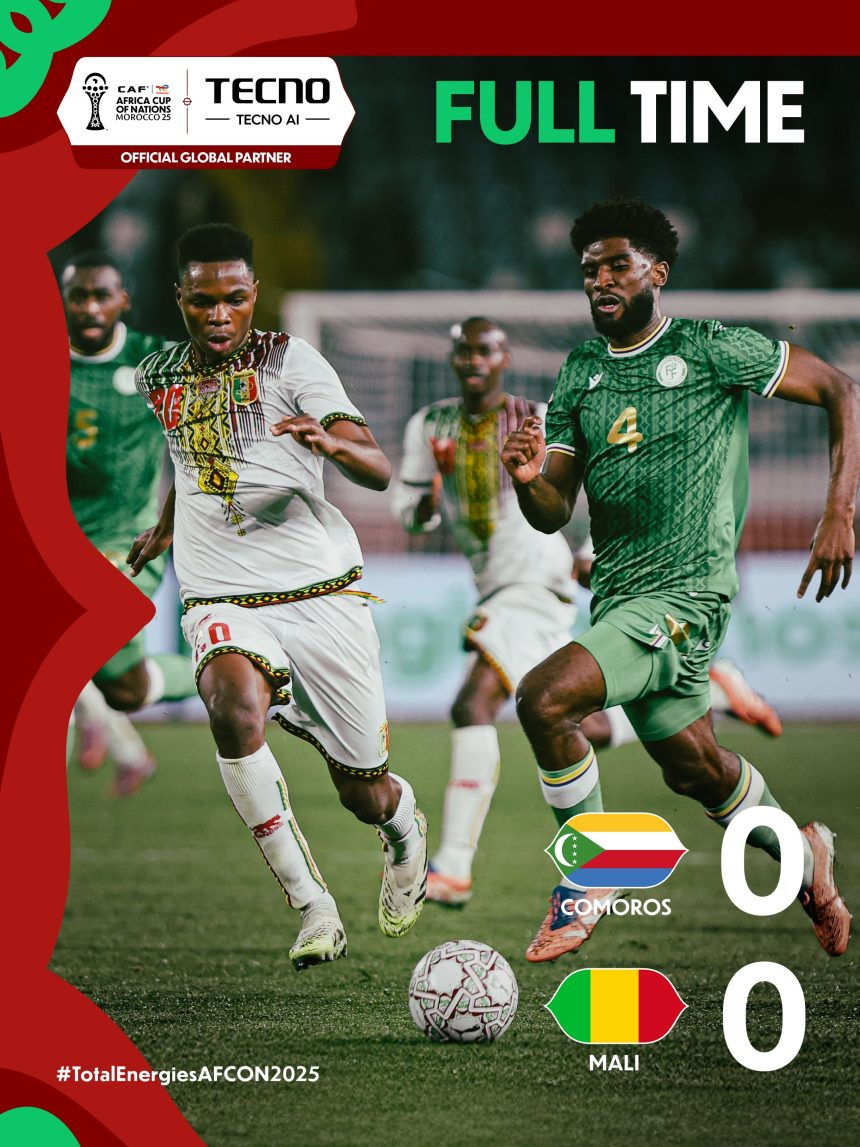
Mali secured their place in the Africa Cup of Nations knockout stages for the fourth consecutive tournament despite being held to a goalless draw by Comoros at the Stade Mohamed V in Casablanca, with the Eagles reduced to 10 men late in the contest following Amadou Haidara’s dismissal.
The stalemate left Mali as Group A runners-up with three points, confirming their progression alongside tournament hosts Morocco who topped the group with seven points. For Comoros, the draw represented their first clean sheet at an AFCON finals but left them third in the standings with just one point, meaning their tournament fate now depends on results elsewhere as they await confirmation of whether they will progress as one of the four best third-placed teams.
Mali entered the encounter knowing a draw would likely be sufficient to secure passage to the last 16, given their superior goal difference over Comoros. The Eagles adopted a controlled approach from the opening whistle, dominating possession and attempting to impose their technical quality on opponents who required victory to guarantee progression.
Comoros, participating in only their second AFCON finals following their round-of-16 appearance in 2021, demonstrated defensive discipline throughout the opening period but struggled to create meaningful attacking opportunities. The Coelacanths sat deep and compact, inviting Mali pressure whilst looking to exploit spaces on the counter-attack through their pace.
The first half proved a frustrating affair for Mali, who enjoyed territorial dominance but found clear-cut chances elusive against Comoros’ well-drilled defensive unit. Captain Yves Bissouma, the Tottenham Hotspur midfielder, attempted to dictate proceedings from deep but found space difficult to exploit as Comoros maintained their compact shape.
Mali’s best opportunity of the opening period fell to Kamory Doumbia, whose effort from the edge of the penalty area was superbly saved by Comoros goalkeeper Yannick Pandor. The shot-stopper, who plays for French Ligue 2 side Rodez, produced several important interventions during the first half to keep Mali at bay.
Faïz Selemani, operating from the right flank, forced another fine save from Pandor in the 16th minute before Bissouma’s long-range effort sailed over the crossbar. The pattern established itself early, with Mali creating half-chances without truly threatening to break the deadlock.
Comoros offered little attacking threat during the opening 45 minutes, content to preserve their defensive organisation and frustrate their more illustrious opponents. The Eagles’ dominance failed to translate into goals, with the teams heading into the interval locked at 0-0.
Mali increased the tempo after the break, recognising that time was running out to secure the victory that would guarantee top spot in the group. Selemani wasted a golden opportunity early in the second period when presented with space inside the penalty area, whilst Mamadou Sangaré saw his effort from distance sail inches wide of the post.
Comoros threatened on the counter-attack as the match opened up, with El Fardou Ben producing their best chance of the contest. The forward found himself in a one-on-one situation with Mali goalkeeper Djigui Diarra, but the experienced shot-stopper produced a superb save to parry away the effort for a corner, preserving parity.
The match took a dramatic turn in the closing stages when Mali midfielder Haidara received his marching orders following a VAR review. The RB Leipzig player was shown a red card for a reckless challenge, leaving the Eagles to play out the final minutes with 10 men and adding tension to an already nervy conclusion.
Despite their numerical advantage, Comoros were unable to capitalise on the situation as Mali defended resolutely during the final stages. The Eagles dropped deeper, protecting their slender hopes of progression by ensuring Comoros could not find the breakthrough that would eliminate them from the tournament.
Both sides created half-chances during five minutes of stoppage time, but neither goalkeeper was seriously tested as the match approached its conclusion. When the final whistle sounded, Mali’s relief was palpable despite the frustration of failing to find the net, whilst Comoros recognised their tournament fate now lay beyond their control.
The result confirmed Mali’s progression to the last 16 for the fourth consecutive AFCON, extending their record of reaching the knockout stages in every tournament since 2013. Coach Éric Chelle will be satisfied with his side’s unbeaten group-stage record, though he will acknowledge that improvements are required if the Eagles are to challenge for major honours.
Mali’s defensive solidity has been their hallmark throughout the group stage, conceding just one goal across three matches. However, their attacking output has been modest, with just two goals scored suggesting greater cutting edge will be necessary against higher-quality opposition in the knockout rounds.
For Comoros, the goalless draw represented both frustration and pride. The Coelacanths kept their first clean sheet at AFCON finals level, demonstrating the defensive improvement that coach Stefano Cusin has instilled. However, their failure to score in two of their three matches highlights the attacking deficiencies that have plagued their campaign.
Comoros now face an anxious wait to discover whether their solitary point will be sufficient to qualify as one of the four best third-placed teams. Their hopes depend on results from Groups C and D, with Tanzania and Uganda both capable of finishing with fewer points in their concluding fixtures on 30 December.
Mali will face the runners-up from Group C in the last 16 on 3 January at the Stade Mohamed V in Casablanca, likely to be Nigeria pending the conclusion of that group’s fixtures. The Eagles will need to improve their attacking output if they are to progress beyond the round of 16 for the first time since reaching the semi-finals in 2013.
The match represented an anti-climactic conclusion to Group A, with both sides appearing content to settle for a result that suited their respective objectives. Mali’s progression continues their impressive recent AFCON record, whilst Comoros’ tournament experience will serve them well as they continue their development as an emerging African football nation.
x
Ten-man Eagles hold on to seal knockout berth as Coelacanths finish third after goalless Casablanca draw
AFCON 2025, Comoros, Mali, goalless draw, Group A, knockout qualification, Casablanca, Stade Mohamed V, Coelacanths, Eagles, Amadou Haidara, red card, Yannick Pandor
Mali secured their place in the Africa Cup of Nations knockout stages for the fourth consecutive tournament despite being held to a goalless draw by Comoros at the Stade Mohamed V in Casablanca, with the Eagles reduced to 10 men late in the contest following Amadou Haidara’s dismissal.
The stalemate left Mali as Group A runners-up with three points, confirming their progression alongside tournament hosts Morocco who topped the group with seven points. For Comoros, the draw represented their first clean sheet at an AFCON finals but left them third in the standings with just one point, meaning their tournament fate now depends on results elsewhere as they await confirmation of whether they will progress as one of the four best third-placed teams.
Mali entered the encounter knowing a draw would likely be sufficient to secure passage to the last 16, given their superior goal difference over Comoros. The Eagles adopted a controlled approach from the opening whistle, dominating possession and attempting to impose their technical quality on opponents who required victory to guarantee progression.
Comoros, participating in only their second AFCON finals following their round-of-16 appearance in 2021, demonstrated defensive discipline throughout the opening period but struggled to create meaningful attacking opportunities. The Coelacanths sat deep and compact, inviting Mali pressure whilst looking to exploit spaces on the counter-attack through their pace.
The first half proved a frustrating affair for Mali, who enjoyed territorial dominance but found clear-cut chances elusive against Comoros’ well-drilled defensive unit. Captain Yves Bissouma, the Tottenham Hotspur midfielder, attempted to dictate proceedings from deep but found space difficult to exploit as Comoros maintained their compact shape.
Mali’s best opportunity of the opening period fell to Kamory Doumbia, whose effort from the edge of the penalty area was superbly saved by Comoros goalkeeper Yannick Pandor. The shot-stopper, who plays for French Ligue 2 side Rodez, produced several important interventions during the first half to keep Mali at bay.
Faïz Selemani, operating from the right flank, forced another fine save from Pandor in the 16th minute before Bissouma’s long-range effort sailed over the crossbar. The pattern established itself early, with Mali creating half-chances without truly threatening to break the deadlock.
Comoros offered little attacking threat during the opening 45 minutes, content to preserve their defensive organisation and frustrate their more illustrious opponents. The Eagles’ dominance failed to translate into goals, with the teams heading into the interval locked at 0-0.
Mali increased the tempo after the break, recognising that time was running out to secure the victory that would guarantee top spot in the group. Selemani wasted a golden opportunity early in the second period when presented with space inside the penalty area, whilst Mamadou Sangaré saw his effort from distance sail inches wide of the post.
Comoros threatened on the counter-attack as the match opened up, with El Fardou Ben producing their best chance of the contest. The forward found himself in a one-on-one situation with Mali goalkeeper Djigui Diarra, but the experienced shot-stopper produced a superb save to parry away the effort for a corner, preserving parity.
The match took a dramatic turn in the closing stages when Mali midfielder Haidara received his marching orders following a VAR review. The RB Leipzig player was shown a red card for a reckless challenge, leaving the Eagles to play out the final minutes with 10 men and adding tension to an already nervy conclusion.
Despite their numerical advantage, Comoros were unable to capitalise on the situation as Mali defended resolutely during the final stages. The Eagles dropped deeper, protecting their slender hopes of progression by ensuring Comoros could not find the breakthrough that would eliminate them from the tournament.
Both sides created half-chances during five minutes of stoppage time, but neither goalkeeper was seriously tested as the match approached its conclusion. When the final whistle sounded, Mali’s relief was palpable despite the frustration of failing to find the net, whilst Comoros recognised their tournament fate now lay beyond their control.
The result confirmed Mali’s progression to the last 16 for the fourth consecutive AFCON, extending their record of reaching the knockout stages in every tournament since 2013. Coach Éric Chelle will be satisfied with his side’s unbeaten group-stage record, though he will acknowledge that improvements are required if the Eagles are to challenge for major honours.
Mali’s defensive solidity has been their hallmark throughout the group stage, conceding just one goal across three matches. However, their attacking output has been modest, with just two goals scored suggesting greater cutting edge will be necessary against higher-quality opposition in the knockout rounds.
For Comoros, the goalless draw represented both frustration and pride. The Coelacanths kept their first clean sheet at AFCON finals level, demonstrating the defensive improvement that coach Stefano Cusin has instilled. However, their failure to score in two of their three matches highlights the attacking deficiencies that have plagued their campaign.
Comoros now face an anxious wait to discover whether their solitary point will be sufficient to qualify as one of the four best third-placed teams. Their hopes depend on results from Groups C and D, with Tanzania and Uganda both capable of finishing with fewer points in their concluding fixtures on 30 December.
Mali will face the runners-up from Group C in the last 16 on 3 January at the Stade Mohamed V in Casablanca, likely to be Nigeria pending the conclusion of that group’s fixtures. The Eagles will need to improve their attacking output if they are to progress beyond the round of 16 for the first time since reaching the semi-finals in 2013.
The match represented an anti-climactic conclusion to Group A, with both sides appearing content to settle for a result that suited their respective objectives. Mali’s progression continues their impressive recent AFCON record, whilst Comoros’ tournament experience will serve them well as they continue their development as an emerging African football nation.