





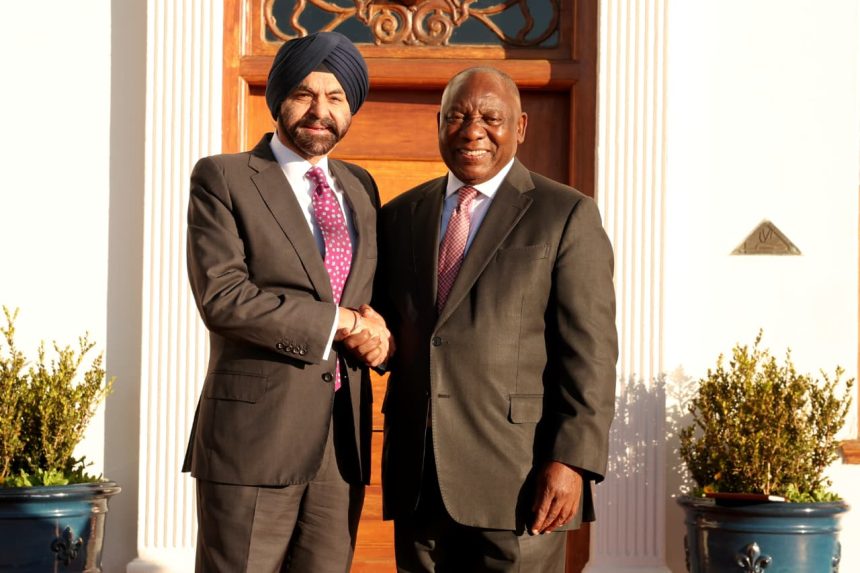
President Cyril Ramaphosa has held talks with World Bank Group President Ajay Banga to deepen their development partnership over the next five years.
The meeting held at Mahlamba Ndlopfu, the official presidential residence in Pretoria, centred on a forthcoming Country Partnership Framework covering the period 2027 to 2032,
which is expected to guide how the World Bank channels technical and financial support into South Africa. Discussions focused on four broad priorities: inclusive infrastructure, strengthening state capability, job-rich economic growth and sustainable development.
The talks come at a critical moment for South Africa, where unemployment remains among the highest in the world. Official figures from Statistics South Africa place the expanded unemployment rate — which includes those who have given up looking for work — at 43.1 percent in the first quarter of 2025, up from 41.9 percent at the end of 2024.
The government has identified job creation and investment in public infrastructure as central to any credible economic recovery plan.
The World Bank has been a long-standing development partner for South Africa, though the relationship has evolved considerably since the end of apartheid in 1994. In recent years, the Bank has provided support in areas including energy transition, water infrastructure and public finance management — sectors where the government has faced sustained pressure.
Mr Banga, who began his five-year term as World Bank Group President on 2 June 2023, has been reshaping the institution’s approach to development financing, placing greater emphasis on private sector mobilisation and climate-aligned investment. His visit to Pretoria signals continued institutional engagement with South Africa as it navigates fiscal constraints and a fragile growth outlook.
South Africa’s economy grew by approximately 0.5 percent in 2024, following growth of around 0.7 percent in 2023 — both figures reflecting sustained weakness that has persisted since the country emerged from the pandemic contraction of 2020. The government has been under pressure to attract foreign investment and unlock infrastructure spending that has stalled in part due to weaknesses in state-owned enterprises, including Eskom and Transnet.
The emphasis on “improving state capability” in the partnership framework discussions points directly to those vulnerabilities. South Africa has repeatedly acknowledged that poor public administration and corruption have undermined service delivery and investor confidence.
No figures were disclosed regarding the financial scope of the new framework, and no joint statement had been issued at the time of publication.
The Country Partnership Framework is expected to be formally concluded ahead of the 2027 implementation date.
