




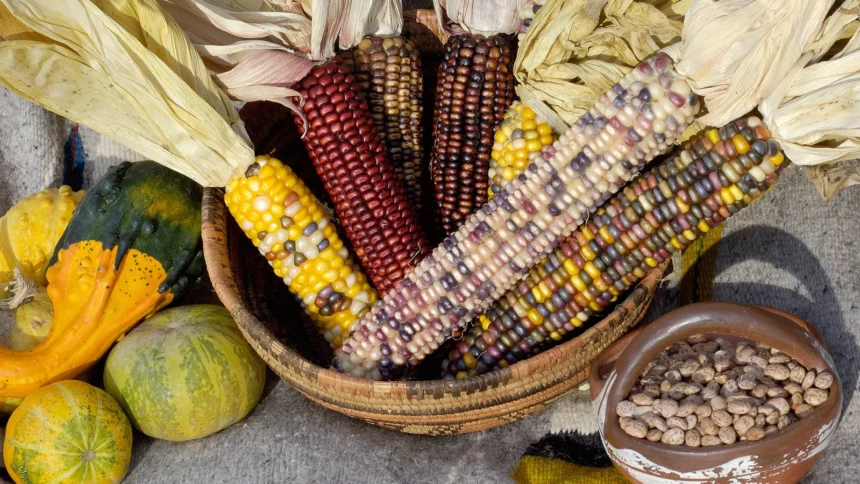
According to Huron-Wendat legend, when the daughter of the original mother passed away, her body gave the world three sisters. In the story, each sister is unique: one stands tall, her long yellow hair blows in the wind. Another wears a bright yellow dress and is known to run off on her own. The third is so young she can only crawl along the ground. Only by working together are they able to flourish and grow – so the trio became inseparable.
But the sisters aren’t people. They’re crops: corn, squash and beans. And the story isn’t just an old myth about cooperation, now shared with tourists who visit the Ekionkiestha’ National Longhouse at the Huron-Wendat Museum, just outside Quebec City. It’s a message from the ancestors of the First Nation that teaches modern Wendat people about the ancient, life-sustaining foods – and a companion planting technique called intercropping that’s so important it survived all the turmoil and cultural losses that came with colonisation.
“Before our dispossession, Lake Huron was our home for centuries,” said Johanne Paquet Sioui, a Wendat seed keeper and farmer. With arable land that stretched from Georgian Bay on Lake Huron to the shores of Lake Simcoe, the region known historically as Wendake or Huronia supported 30,000 to 35,000 Wendat people.
They lived in settlements surrounded by defensive palisades, with each village containing as many as 100 longhouses. Shared by four or five families, the large rectangular homes were built from log frames and covered with rounded roofs and walls made of cedar, fir or spruce bark. Windowless – the longhouses had two entrances, one at each end. Inside, the walls would have been lined with shelf-like beds that had food storage above them and wood piles beneath. Running in a row down the centre would have been cooking fires where a one-pot meal made from corn, beans and squash, called sagamité, may have simmered.
Back then, the three sisters made up some 60-80% of the Wendat diet, and the Wendat culture, like many others across North America, was centred on the plants’ cultivation. Sioui said the men cleared the land and then the women and children would build up dirt piles and plant the beans. As the small seedlings began to grow, the farmers returned and placed corn kernels in the centre of the mounds (theories vary on whether it was corn or beans that were planted first). Next, winter squash was sown. As the plants matured, the cornstalks served as bean poles while the large squash leaves shaded the soil, creating a microclimate that preserved moisture and inhibited weeds.
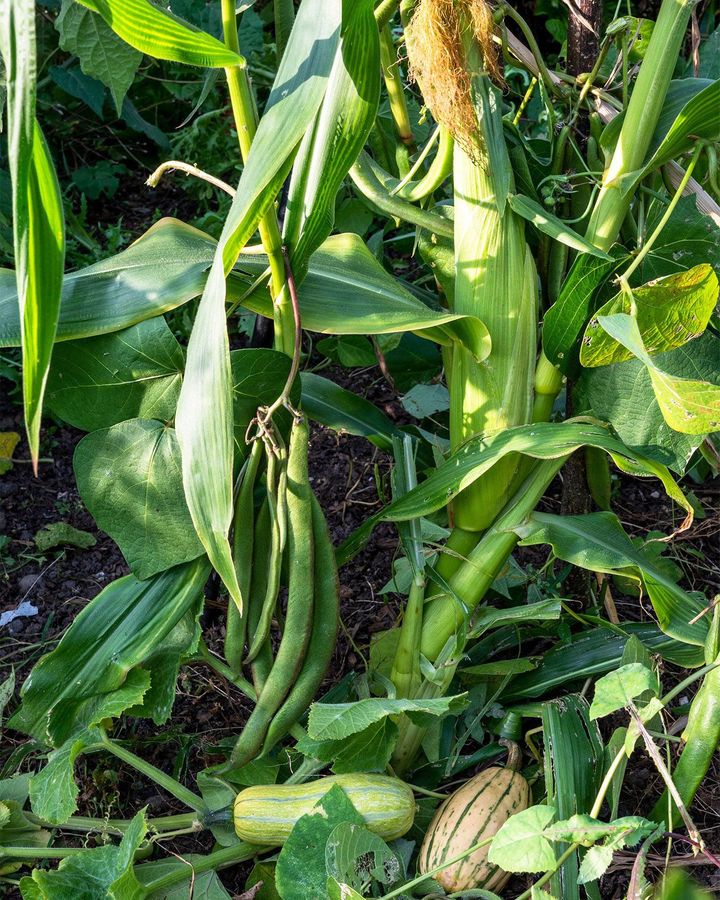
The “three sisters” are planted together with a technique called intercropping (Credit: Maggie Sully/Alamy)
Today we know that planting corn, beans and squash together results in better disease resistance, less reliance on fertilisers and improved crop yields. But for the Wendat people, it was a sacred act that respected ancient teachings. “We don’t pray, instead we’re taught to make thanksgiving,” said Sioui. “For everything we are grateful for, we learn we have a responsibility to keep it that way.”
At the end of the growing season, the vegetables were harvested and stored for winter. Corn and beans were dried and kept in the longhouse in bark or wooden containers. As far as possible, everything was used. Corn husks were braided for rope and twine, or used as filling for pillows and mattresses. The best seeds were selected and saved for the next season’s planting by the seed keepers, whose job it is to collect and protect seeds.
But by 1650, the farms and village sites of Huronia or Wendake were empty. Thousands of Huron-Wendat people had succumbed to diseases including smallpox, influenza and measles, while others perished in the French and Iroquois Wars – a series of territorial and trade battles between the French, Haudenosaunee (Iroquois), English and other First Nations.
What they didn’t lose were their seeds
Only some 500 Huron-Wendat are said to have survived and escaped, and for 200 years, they didn’t have a homeland. “The old and the young died. They lost almost everything… their homes, their culture, their skills,” said Sioui. What they didn’t lose were their seeds, and every year, as they moved across the landscape, the men prepared the land, and the women planted the three sisters. And every year, after the harvest, the seed keepers saved seeds for the next spring.
Then, in 1853, the Huron-Wendat People were allotted reserve land; according to the Indian Act, it measured three by five miles and was located at the edge of Quebec City in what was then Lower Canada. They had a home, but as on most reserves in Canada, there was no arable space provided for agriculture or other food production.
“The last garden we harvested was in 1853,” said Sioui.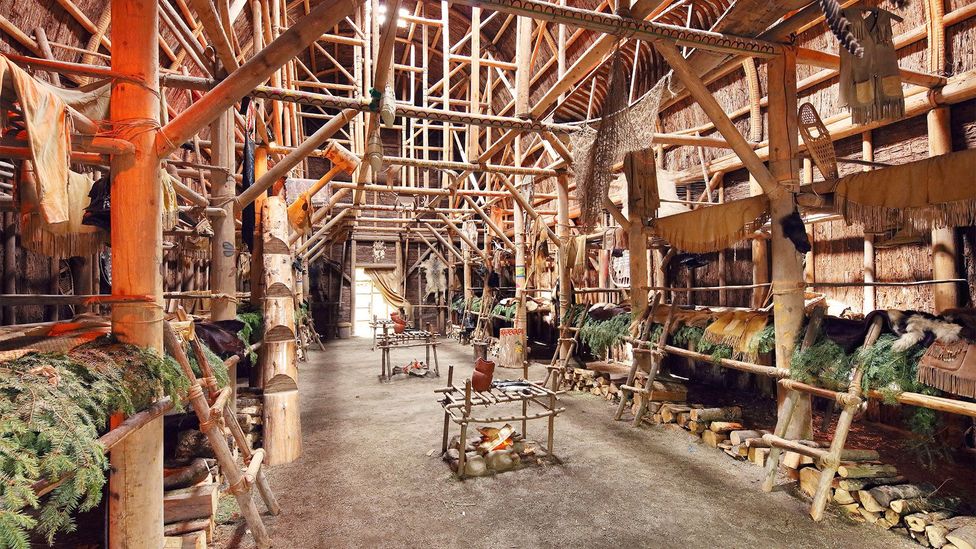
The Huron-Wendat Museum houses the Ekionkiestha’ National Longhouse (Credit: All Canada Photos/Alamy)
The three sisters don’t just nurture the soil and each other. According to Sioui, the three vegetables combined are exceptionally nutritious. Studies say that a diet based on maize, beans and squash can meet peoples’ basic energy and protein requirements and can also help guard against diabetes. They’re also high in antioxidants and provide trace minerals and folate, which guards against birth defects. But with the loss of farmland and the introduction of European staples including sugar, flour and butter, this ancient diet was almost completely replaced. The results were catastrophic.
Elders say that the loss of traditional foods is almost as damaging as the loss of language. Losing food systems severs a people’s relationship with the natural world, the land, the plants and the seasons. It also takes away the intergenerational skills and celebrations that revolve around food sovereignty: spreading seeds or saving them, gathering together for harvests or for feasts.
“First Nations people have forgotten they were farmers. For a long time, we’ve just been survivors.”
Kyle Bobiwash, assistant professor in the Department of Entomology and the Indigenous scholar for the faculty of Agricultural and Food Sciences at the University of Manitoba, said this is why it’s so important for Indigenous people to be supported by governments and scientists as they relearn their traditions. “First Nations people have forgotten they were farmers. For a long time, we’ve just been survivors.”
As one of the collaborators on the Three Sisters research project in Quebec, which focuses on Indigenous-led agriculture alongside Huron-Wendat and Haudenosaunee people and Agriculture and Agri-Food Canada, Bobiwash said the project is guided by the ongoing goals of the Indigenous participants. After moving through the first phase in 2015, which included a search for ancestral seeds –that turned up Algonquin white and red Mohawk maize, Amish nuttle (also called corn hill) and macuzalito beans, and Algonquin Canada crookneck squash – the project turned to studying the comparative nutritional components of the ancestral plants. After that, they experimented with bean and corn flours to make a modern version of traditional Mohawk cornbread.
“We (scientists) are not here to validate this type of food or of intercropping – we can already look back at thousands of years and see the productivity,” Bobiwash said.
Instead, the project is designed to offer support and agency while Indigenous communities decide what they want to know or learn about their traditional crops. At the same time, the scholars and scientists are trying to discover what else the three sisters can teach us about biodiversity and sustainability. “We know we need to do agriculture differently… to think about food systems differently,” said Bobiwash, and bringing Indigenous knowledge and values into agriculture might be one solution. “The ancestors knew these systems worked; they may not have known why, but maybe that information was lost along the way.”
As the Huron-Wendat begin to reclaim their traditional food systems through the Three Sister’s project, small community gardens and demonstration plantings at Huron-Wendat Museum, they’ve been able to strengthen their culture. At the same time, other aspects of Wendat heritage are also being revitalised. The Wendat language, which nearly went extinct, is now taught in primary schools and to interested adults. And tourism is offering a way for young people to be proud of their culture while sharing their knowledge and history.
The Huron-Wendat Museum and the Huron Traditional Site Onhoüa Chetek8e show how rich the past was – with full-size replica longhouses and opportunities for visitors to learn about the culture through hands-on experiences like canoeing or making a traditional talking stick, which was used in longhouses to determine who had the right to speak. The new Onhwa’ Lumina night walk helps bring the language and culture to life with a high-tech collaboration that tells ancient Wendat stories through lights and sound in a forested setting.
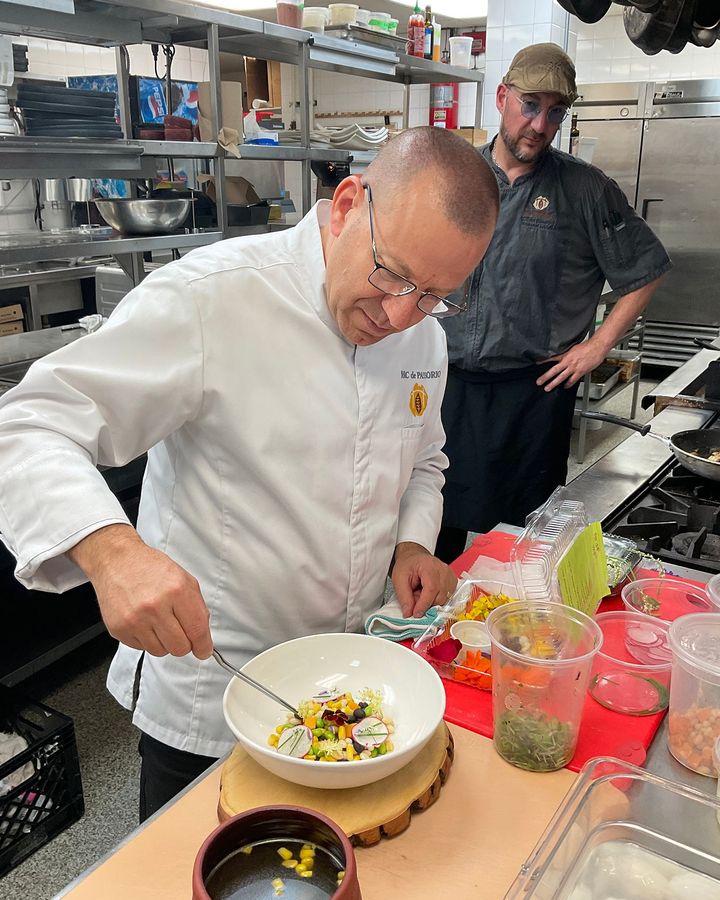
Chef Marc de Passorio prepares sagamité (Credit: Hôtel-Musée Premières Nations)
And at La Traite, a gourmet restaurant in Wendake, patrons are able to taste dishes influenced by Indigenous foods – including a modern take on sagamité. The kitchen is newly helmed by Marc de Passorio, a Michelin-starred chef who came to Le Traite for the opportunity to learn from Indigenous cooks and Elders. “Today I am a complete apprentice: I try to see, understand and experience as much as possible from the First Nations,” he said.
With 11 Indigenous Nations spread across Quebec in 55 communities, de Passorio is making a point of getting out on the land and to learn how Indigenous elders hunt, fish, harvest and prepare their traditional foods. Then he and his all-Indigenous kitchen team adapt the ingredients and cooking techniques for contemporary palates. “The First Nations people didn’t use salt, so we add that. But we don’t play too much with tradition. We want to be respectful.”
The goal is to have a seasonal menu that incorporates the different berries, spices, woods, meats and vegetables he learns about as he travels to communities around the province. “People in different places harvest different foods at different times and use them in different ways, so I am gathering recipes and ideas,” he said. “I ask everyone what they eat.”
While the seasonal menu will reflect what he learns; the simple soup of beans, corn and squash will always remain the star. “I learned the story of the three sisters when I came. Before then, I had cooked beans, corn and squash, but never together. But together they are… fantastic,” he said. “Our menu will change, but the sagamité will never come off – it’s too important.”
Sioui, who is culturally tasked with saving the seeds after each harvest and for the future, agrees. When she thinks of what it took for the seeds to survive, it becomes hard for her to speak, “They are good for our health, good for our heritage. They are holy.”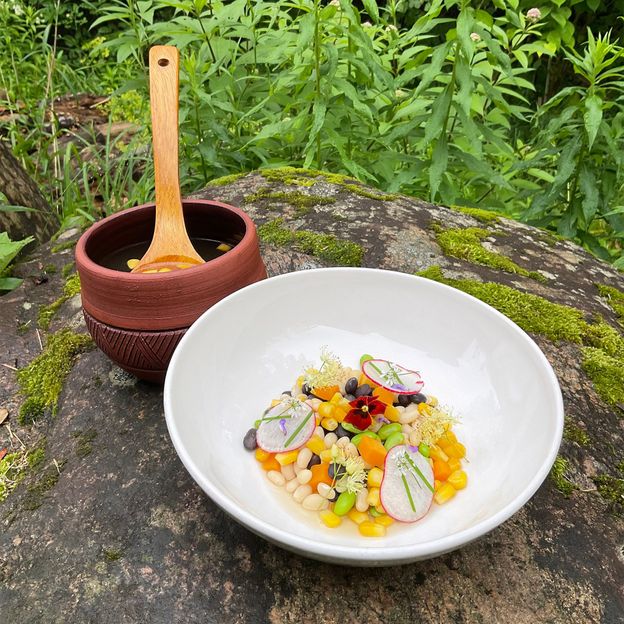
Chef Marc de Passorio’s version of “three sisters” sagamité (Credit: Hôtel-Musée Premières Nations)
Three-Sisters Sagamité (serves 4)
By Marc de Passorio (La Traite)
Makes a light soup, suitable for a starter
Ingredients:
40g dried black beans
20g dried white beans
0.4kg butternut squash
20g corn
¼ onion, diced
2l vegetable broth
5g fresh sage, chopped
fleur de sel to taste
pepper to taste
Instructions:
1. Soak the beans in water overnight.
2. The next day, drain the beans, and then fill a pot with water and add the beans to it.
3. Cook over low heat for two hours or until tender. Drain the beans.
4. Cut the butternut squash into pieces and add it to the corn and onion, and then sauté in oil for 30 minutes.
5. Season with salt and pepper and add sage and beans.
6. Separately, heat the broth and then pour over even portions of the three sisters’ preparation.
7. Serve.